
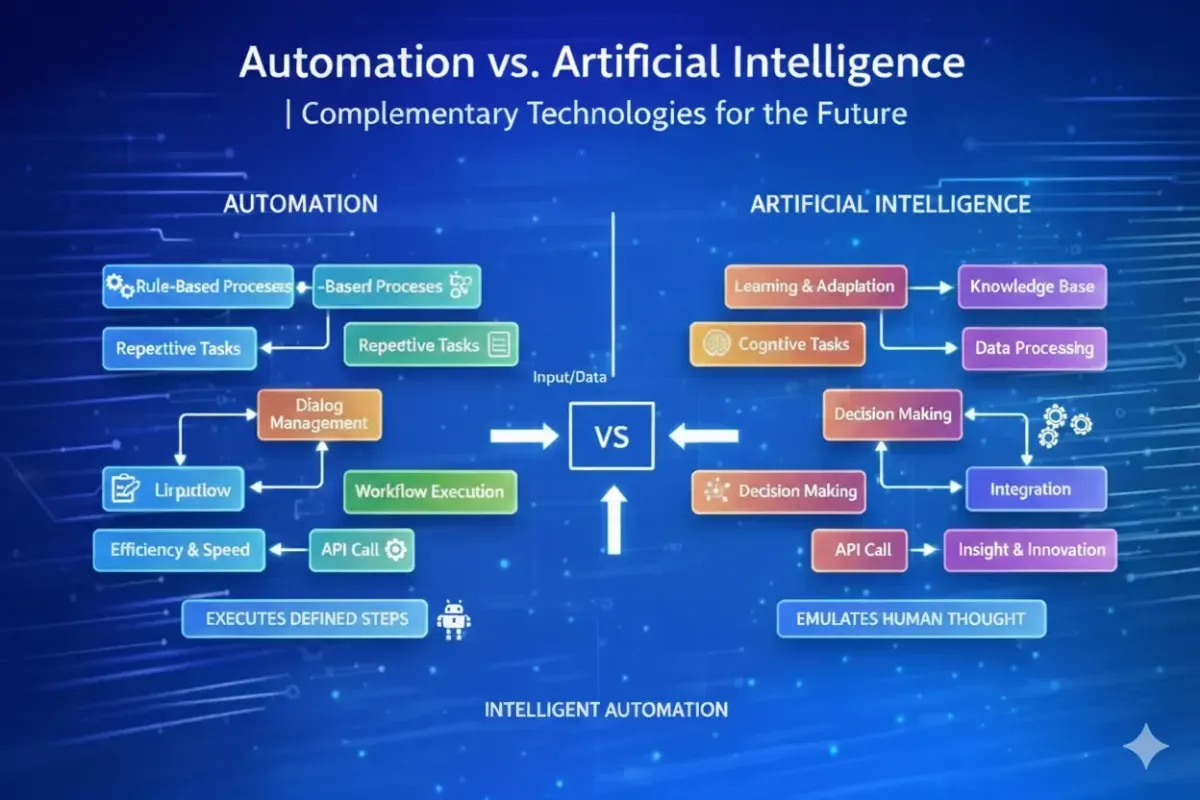
Automation vs. Artificial Intelligence: A Detailed Explanation
Automation and Artificial Intelligence (AI) are often discussed together, frequently conflated, and regularly misunderstood. In boardrooms, sales decks, and product roadmaps, the terms are used interchangeably—yet from a technical, economic, and operational standpoint, they represent fundamentally different capabilities.
This distinction matters.
Misunderstanding the boundary between automation and AI leads to fragile systems, compliance risk, inflated expectations, and poor return on investment. Conversely, organisations that clearly understand how automation and AI differ—and how they should be architected together—build systems that scale efficiently, adapt intelligently, and compound competitive advantage over time.
This article provides a rigorous, first-principles explanation of automation versus artificial intelligence, examining their technical foundations, economic characteristics, risk profiles, and optimal architectural patterns. The goal is not to position one as superior, but to define where each belongs—and why the most effective modern systems deliberately integrate both.
1. Core Definitions (First Principles)
Automation
Automation is the execution of predefined rules to perform tasks with minimal or no human intervention.
At its core, automation is deterministic. Humans explicitly design the logic, define the conditions, and specify the actions. Once deployed, the system behaves exactly as instructed until a human changes the rules.
Key characteristics of automation:
Logic is human-designed and rule-based
Behaviour is deterministic
Identical inputs always produce identical outputs
Outcomes are predictable and repeatable
The system does not learn or adapt on its own
Automation answers a single question:
“When X happens, do Y.”
Examples include workflow automations, scripts, triggers, scheduled jobs, robotic process automation (RPA), and system-to-system integrations.
Automation excels when processes are stable, inputs are structured, and the cost of failure must be close to zero.
Artificial Intelligence (AI)
Artificial Intelligence refers to systems capable of performing tasks that normally require human cognitive abilities—such as reasoning, learning, language understanding, perception, and decision-making.
AI systems do not follow fixed rules. Instead, they infer patterns from data and generate probabilistic outputs based on context, goals, and prior training.
Key characteristics of AI:
Logic is probabilistic rather than deterministic
Behaviour is context-aware
Outputs are non-deterministic
The system generalises from data instead of following hard rules
Performance improves through training, feedback, or refinement
AI answers a fundamentally different question:
“Given this context and objective, what is the most appropriate response?”
Examples include language models, recommendation systems, fraud detection engines, computer vision systems, and predictive analytics.
AI excels in environments where ambiguity, variability, and unstructured data are unavoidable.
2. Determinism vs. Probability
The most important technical distinction between automation and AI lies in how decisions are made.
Automation: Deterministic Logic
Automation systems operate using explicit rules. Given the same input, the same output is guaranteed.
If condition A is true → execute action B
Else → execute action C
This predictability makes automation reliable, auditable, and easy to reason about. However, it also makes it brittle. If an input does not match a predefined condition, the system fails or behaves incorrectly.
AI: Probabilistic Reasoning
AI systems operate by evaluating probabilities across many possible outcomes. Even with the same input, the output may vary depending on context, randomness, or model state.
Rather than binary success or failure, AI performance exists on a spectrum—from poor to excellent.
Key insight:
Automation is exact
AI is approximate
This difference underpins nearly every architectural, economic, and governance decision that follows.
3. How Decisions Are Made
Automation Decision Model
Automation follows a linear, state-based decision flow:
An event occurs (e.g. a form submission)
Conditions are evaluated (if / else)
A predefined action is executed
The workflow ends or branches
Technically, this resembles a finite state machine. Every possible path must be anticipated in advance.
This model is highly effective for:
Lead routing
Data validation
Status changes
Notifications
Compliance-driven processes
But it breaks down when interpretation or judgment is required.
AI Decision Model
AI operates as a reasoning engine rather than a workflow:
Input is received (text, voice, data)
Context is assembled (instructions, memory, retrieved knowledge)
The model evaluates probabilities across potential responses
A best-fit output is generated
Feedback may influence future behaviour (depending on system design)
There is no explicit decision tree. Instead, the system infers intent and generates an output that satisfies the objective within its learned constraints.
This model is ideal for:
Natural language interaction
Pattern recognition
Classification
Prediction
Synthesis and summarisation
4. Data Requirements
Automation Data Requirements
Automation depends on structured, predictable data:
Fixed schemas
Known fields
Boolean logic (true / false)
Minimal ambiguity
Automation fails when:
Inputs are incomplete
Data is inconsistent
Exceptions are frequent
Meaning must be inferred
In such cases, rule complexity increases rapidly, leading to “rule sprawl” and escalating maintenance costs.
AI Data Requirements
AI systems can operate on:
Unstructured data (text, images, audio)
Semi-structured data
Natural language inputs
Partial or noisy datasets
AI degrades gracefully:
Poor data leads to weaker outputs
Missing data leads to inference (with risk)
Ambiguity produces probabilistic responses
This flexibility makes AI uniquely powerful—but also inherently less predictable.
5. Strengths and Weaknesses
Automation Strengths
Extremely reliable
Fully auditable and explainable
Scales cheaply once built
Compliance-friendly
Ideal for revenue-critical processes
Automation Weaknesses
Brittle in edge cases
Requires extensive upfront design
Rule sprawl increases long-term cost
Cannot reason or interpret intent
AI Strengths
Handles language, nuance, and intent
Reduces manual cognitive effort
Adapts to variability
Excels at interaction and analysis
AI Weaknesses
Non-deterministic outputs
Hallucination risk
Harder to audit and explain
Dependent on prompt quality and data quality
6. Cost and Scalability Characteristics
Automation Economics
Automation typically involves:
Higher upfront implementation cost
Low marginal cost per execution
Predictable infrastructure usage
Linear, stable scaling
Once built, automation becomes cheaper as volume increases.
AI Economics
AI typically involves:
Lower initial setup cost
Ongoing inference or compute costs
Token-based or usage-based pricing
Costs scale with volume and complexity
Strategic implication:
AI is cheaper to start
Automation is cheaper to run at scale
This has significant implications for system design and long-term ROI.
7. Governance, Risk, and Compliance
Automation Risk Profile
Fails loudly
Easy to debug
Clear ownership
Low regulatory ambiguity
Automation errors are visible and traceable, which simplifies compliance and incident response.
AI Risk Profile
Fails subtly
Requires monitoring and guardrails
Needs human oversight
Introduces regulatory exposure (GDPR, explainability, data usage)
AI systems demand active governance, especially when deployed in customer-facing or decision-critical contexts.
8. Typical Use Cases
Automation Is Best For
Lead routing
CRM updates
Status changes
Notifications
Billing and invoicing
Compliance workflows
System-to-system data movement
AI Is Best For
Conversational interfaces
Lead qualification via dialogue
Content generation
Data summarisation
Semantic search
Decision support
Attempting to force either technology outside its natural domain typically results in poor outcomes.
9. The Critical Mistake: Treating AI as Automation
One of the most common failures in modern system design is attempting to replace deterministic workflows with AI.
This usually involves:
Removing explicit rules
Allowing AI to “decide” outcomes
Delegating revenue-critical logic to probabilistic systems
The result is:
Inconsistent behaviour
Lost attribution
Compliance risk
Unexplainable outcomes
AI should inform decisions. Automation should execute them.
10. The Optimal Architecture: Automation and AI Together
The highest-performing systems do not choose between automation and AI. They integrate them deliberately.
Reference Pattern
Automation triggers on a deterministic event
AI interprets, enriches, or classifies context
Automation applies rules to AI output
Deterministic action is executed
In this architecture:
AI functions as the reasoning layer
Automation functions as the execution layer
This separation preserves reliability while unlocking intelligence.
11. Mental Model Summary
Automation is a machine
AI is a cognitive assistant
Automation replaces labour
AI augments judgment
Automation guarantees outcomes
AI improves decisions
Final Perspective
From a forward-looking, operational standpoint:
Automation is the backbone of scalable systems
AI is the brain that enables adaptation
Systems without automation do not scale
Systems without AI do not learn
The competitive advantage does not come from choosing automation or AI in isolation. It comes from engineering the boundary between them correctly—using AI to reason and automation to act.
Organisations that master this distinction build systems that are not only efficient but resilient, adaptive, and strategically defensible.