
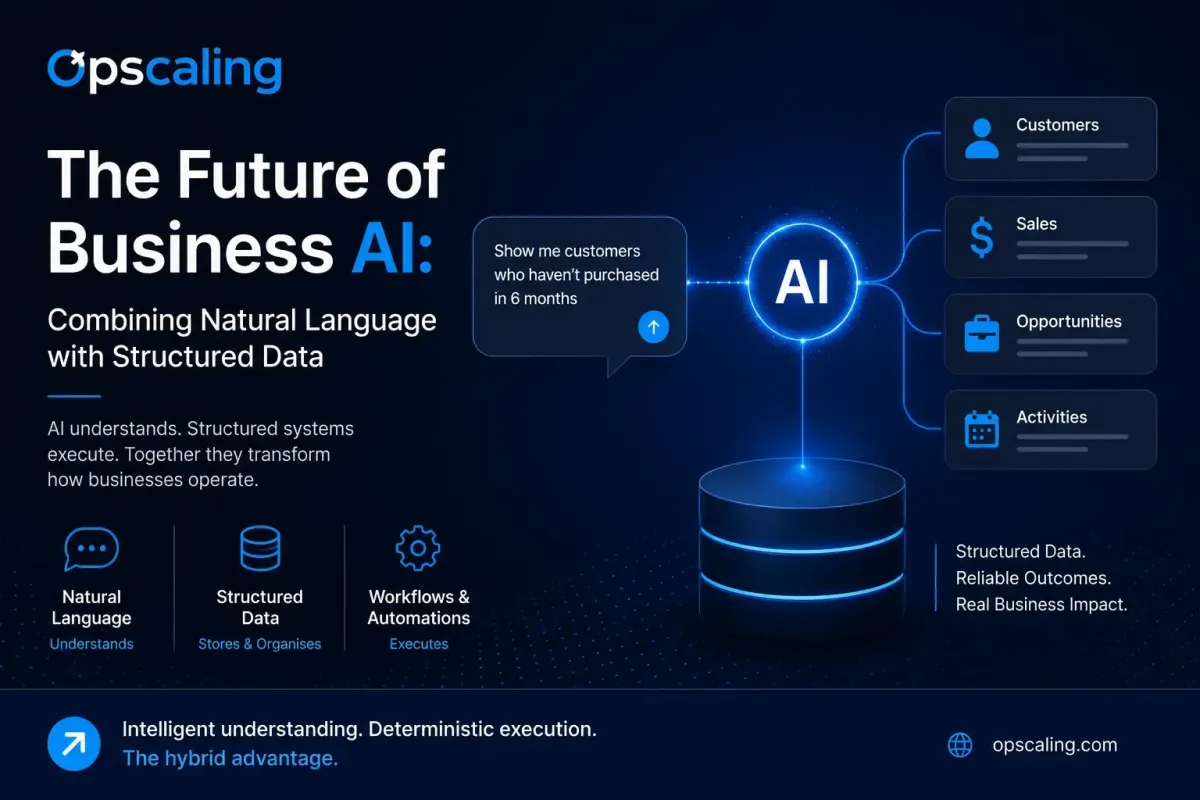
Combining Natural Language and Structured Data in Business AI
Over the past few years, artificial intelligence has transformed how businesses interact with software. Employees can now ask questions in plain English, summarise documents, analyse emails, generate reports and even control applications simply by describing what they want. Many businesses, therefore, assume that AI will eventually replace traditional software altogether. It will replace some software, but not all. Instead, the most successful organisations are discovering something far more powerful. The future belongs to businesses that combine the flexibility of natural language with the reliability of structured data. Rather than replacing databases, CRMs, workflows and business rules, AI sits on top of them, acting as an intelligent interface that allows humans to interact with structured systems naturally. This hybrid approach is becoming the foundation of modern business automation.
The fundamental misunderstanding that plagues many AI adoption strategies is the belief that probabilistic models can somehow replace deterministic systems. They cannot. They were never designed to. Large Language Models excel at interpretation, classification and generation, but they are fundamentally unsuited to the precise, repeatable operations that underpin business operations. When an organisation attempts to use AI as its system of record, it introduces fragility into its core infrastructure. The correct approach is to use AI as a translation layer that converts human communication into structured business data, leaving the deterministic systems to handle execution, storage and reporting.
The Fundamental Difference Between Two Worlds
Business software has traditionally relied upon structured information. Customer records, product catalogues, invoices, CRM pipelines, order histories, appointment schedules, financial transactions and inventory systems all share a common characteristic. Everything has a predefined place. Every field has a specific meaning. Every workflow follows clearly defined rules. Computers excel at this type of information because it is deterministic. Given the same inputs, the same outcome always occurs. This predictability is what makes business systems reliable, auditable and scalable.
Artificial intelligence works very differently. Large Language Models do not operate using rigid rules. Instead, they analyse probabilities. When you ask ChatGPT a question, it predicts the most likely sequence of words based upon everything it has learned. That makes AI incredibly flexible. It also makes it fundamentally different from traditional software. The distinction is not merely technical. It shapes how each technology should be deployed, what tasks each should perform and how they should interact within a modern business architecture.
Deterministic Versus Probabilistic Systems
One of the biggest misunderstandings surrounding AI is assuming it thinks like traditional software. It does not. Traditional software answers questions like this: if X happens, perform Y. AI answers questions more like this: based upon everything I know, this is probably what you mean. Both approaches are incredibly useful. Neither replaces the other. Instead, they solve different problems.
Deterministic systems are exact, repeatable and structured. They operate on rules, deliver perfect calculations and provide reliable execution. Probabilistic AI is approximate, contextual and natural language-based. It reasons, offers human-like understanding and enables flexible interaction. Modern organisations need both. The key is understanding which problems belong to which domain and designing systems that allow each to operate in its area of strength.
Consider a customer relationship management system. The database tables, field definitions, validation rules and workflow automations are deterministic. They guarantee that every opportunity has a stage, every contact has an email address, and every closed deal updates the forecast correctly. The AI component interprets customer emails, classifies enquiry types and extracts key information. The deterministic system ensures consistency. The probabilistic system enables understanding. Together, they create a complete solution that neither could achieve alone.
Why Natural Language Changes Everything
Business software has traditionally required people to adapt to computers. Employees learn forms, memorise menus, navigate dashboards and search databases. AI reverses this relationship. Instead of humans learning software, software learns humans. Rather than clicking through dozens of screens, someone can simply ask: " Show me customers who haven't purchased in six months. Or: which opportunities are likely to close this month? Or: summarise today's customer complaints. The employee speaks naturally. The AI translates that request into structured operations. This dramatically reduces training requirements while making complex systems accessible to everyone.
The implications extend far beyond convenience. When natural language becomes the primary interface, business intelligence becomes democratised. Frontline employees can access insights that were previously locked behind complex reporting tools. Managers can monitor performance without waiting for scheduled reports. Customer service representatives can retrieve complete customer histories in seconds. The barrier between business data and business decision-makers evaporates. This does not diminish the importance of structured data. On the contrary, it increases it. The more accessible data becomes, the more critical its quality becomes.
Structured Data Remains the Foundation
Although AI changes how we interact with software, structured data remains essential. Imagine asking AI: Which customers generate the highest profit? If your CRM has inconsistent customer records, duplicated contacts and incomplete sales information, the AI cannot magically invent accurate answers. AI depends upon high-quality data. Garbage in, garbage out. The organisations achieving the greatest success with AI have invested heavily in clean databases long before introducing AI assistants. Structured information remains the single source of truth. AI simply makes it easier to access.
This principle extends to every aspect of business operations. AI classification, summarisation and extraction are only as valuable as the structured data they produce. Workflows automate and enforce rules based upon that data. Reporting, dashboards and KPIs depend upon consistent, accurate, structured information. When businesses shortcut this foundation, they build AI capabilities upon sand. The initial demonstrations may impress, but the long-term value never materialises.
AI Should Not Become Your Database
Many businesses make a critical mistake. They allow AI conversations to become the primary location where information is stored. Instead of updating CRM fields, employees simply ask AI questions. Instead of recording customer preferences, they leave everything buried inside conversations. This creates hidden knowledge. Information becomes impossible to report upon, impossible to automate and impossible to analyse.
Instead, AI should continuously convert conversations into structured business information. For example, when a customer says: We would like to postpone until September, the AI extracts the opportunity status, estimated close date, customer intent and sales stage. Those values update the CRM automatically. Now reporting, forecasting, and automation continue to work perfectly. The conversation is not the system of record. The structured data is. The AI simply enables the translation from natural language to structured fields.
This approach preserves the auditability and reliability of deterministic systems while gaining the flexibility of AI. Every customer interaction becomes structured business data. Every AI output becomes reusable. Good CRM architecture makes AI significantly more valuable because it provides a clear destination for the structured information that AI extracts.

AI as an Intelligent Translator
Perhaps the best way to think about AI is as a translator. Humans communicate using conversations, emails, documents, voice, images and messages. Business systems require fields, tables, relationships, records, statuses and numbers. AI converts one into the other. Natural language becomes structured business data. Structured business data becomes meaningful insights. That translation layer is where AI creates enormous commercial value.
Consider the typical sales enquiry. A potential customer sends an email expressing interest in a product or service. The email contains budget information, timeline expectations, decision-making authority details and specific requirements. In a traditional system, a salesperson reads the email, interprets the information and manually updates the CRM. This process is slow, error-prone and inconsistent. With AI, the email is processed automatically. The budget is extracted and validated against qualification thresholds. The timeline is converted to a projected close date. Decision-maker relationships are mapped. Requirements are categorised and prioritised.
Capture Intent, Then Validate
The intelligence layer must capture intent before updating records. This is a crucial design principle that distinguishes successful AI implementations from failed ones. AI should interpret natural language and propose structured updates. Validation workflows should then verify those proposals before they become permanent records.
This separation provides several benefits. First, it allows for human oversight where required. Ambiguous or high-stakes decisions can be flagged for review. Second, it enables quality control. The validation layer can check that extracted data meets business rules and formatting requirements. Third, it creates an audit trail. Every AI-suggested update is logged, allowing organisations to monitor performance and identify improvement areas.
For example, when a customer expresses interest in a premium product tier, the AI captures that intent and proposes updating the opportunity stage and product interest fields. The validation workflow checks whether the customer qualifies for that tier, whether the proposed stage change aligns with sales methodology and whether the account team has been notified. If all checks pass, the update proceeds automatically. If not, the workflow routes the proposal for human review. This hybrid approach combines AI's interpretive power with deterministic validation.
Use AI to Populate Custom Fields, Pipeline Stages and Relationships
Modern CRMs support extensive customisation. Businesses define custom fields, pipeline stages and relationship types that reflect their unique operations. AI can populate all of these automatically. This is where the true power of natural language integration becomes apparent.
Instead of forcing employees to navigate complex forms and select from dropdown menus, AI interprets natural language descriptions and populates the appropriate custom fields. A customer says: we are a manufacturing company with fifty employees and an annual revenue of approximately five million pounds. The AI extracts the industry, company size and revenue band, then updates the corresponding custom fields. The pipeline stage is adjusted based on buying signals. Relationships between contacts, companies and opportunities are mapped automatically.
The result is a CRM that remains current without manual data entry. Employees interact naturally with the system. The structured data beneath the interface stays accurate and complete. This is the promise of AI integration, and it is achievable today with the right architecture.
Separating Understanding from Execution
One design principle is becoming increasingly important. Separate reasoning from execution. AI decides what someone means. Traditional systems decide what happens next.
For example, a customer emails: we are probably interested, but need approval from finance. The AI determines positive buying intent, decision delayed and finance approval is required. The CRM updates automatically. Traditional workflows then schedule a follow-up, notify the account manager, update the sales forecast and create a reminder. AI understands. Business systems execute. Each technology performs the task it does best.
Use AI for Decisions That Require Judgment, Use Rules for Repeatable Processes
The distinction between judgment and execution is fundamental to successful hybrid architecture. AI should be deployed for decisions that require interpretation, nuance or contextual understanding. Rules and workflows should handle repeatable, predictable processes.
Consider a customer support scenario. A customer submits a complaint that mentions frustration with a specific feature. The AI classifies the complaint, assesses sentiment and summarises the key issue. The workflow then routes the ticket to the appropriate team, sets priority based upon severity and enforces service-level agreements. The AI handles the interpretive work. The workflow handles the deterministic execution.
This separation provides several advantages. AI is freed from rigid rule enforcement, which it performs poorly. Workflows are freed from interpretive tasks, which they cannot perform at all. Each component focuses on its area of strength. The overall system becomes more robust, more accurate and more efficient.
AI Should Augment Business Logic, Not Replace It
Business logic represents the accumulated wisdom of an organisation. It embodies rules, policies and best practices developed over years of operation. AI should augment this logic, not replace it. The goal is not to have AI make all decisions but to have AI inform and accelerate human and system decision-making.
For instance, a credit approval workflow might traditionally require manual review of customer applications. AI can be deployed to extract and summarise relevant information from applications, flag potential risks and recommend initial decisions. The business logic, embodied in rules and approval matrices, remains the ultimate authority. AI augments the process by reducing manual effort and improving consistency, but it does not replace the structured decision framework.
This approach preserves auditability and accountability. When AI assists rather than replaces, organisations can maintain clear lines of responsibility. Errors can be traced, corrected and learned from. The system improves over time without sacrificing the reliability of deterministic logic.
Better Reporting Through Structured AI
Reporting has always depended upon structured information. Dashboards cannot analyse free text efficiently. However, AI can convert thousands of conversations into measurable business metrics.
Instead of reading every customer email, management might see the most common objections, top product requests, frequently requested features, customer sentiment, buying intent, cancellation reasons and support trends. The underlying reports still rely upon structured data. AI simply creates that data automatically.
Every AI Output Should Become Structured, Reusable Business Data
This principle is the cornerstone of effective AI integration. Every AI output must become structured, reusable business data. Nothing should remain buried in AI conversations or hidden in unstructured notes.
Consider a sales team that conducts discovery calls with potential customers. Traditional practice might involve taking notes during the call and storing them in the CRM as free text. Those notes are essentially useless for reporting, analysis or automation. With AI, the call is transcribed, key information is extracted and structured fields are updated. Budget, timeline, decision-makers, requirements and competitive landscape all become structured data. Now the organisation can report on average deal size by industry, identify patterns in competitive losses and automate follow-up sequences based upon prospect readiness.
Good CRM Architecture Makes AI Significantly More Valuable
The quality of AI automation depends upon the quality of structured data. This truth cannot be overstated. A well-designed CRM with clean data, clear field definitions and consistent workflows enables AI to deliver transformative value. A poorly designed CRM with inconsistent data and unclear structures frustrates AI and produces unreliable results.
Organisations should therefore design databases for reporting first and AI second. Reporting requirements define the necessary fields, relationships and data quality standards. AI then populates those fields through natural language interpretation. This sequencing ensures that data structures support business needs regardless of how the data is collected. AI becomes an enabler of great data architecture rather than a workaround for poor design.
From Forms to Conversations
Traditionally, businesses collected information using forms. Customers completed dozens of fields. Many abandoned the process. AI allows businesses to collect the same information naturally. Instead of asking customers to complete a complex questionnaire, they simply describe their requirements. AI extracts the budget, industry, project type, company size, timescales and contact information. The CRM is populated automatically. The customer enjoys a far more natural experience.
Design Databases for Reporting First, AI Second
This design principle reinforces the importance of data architecture. When designing databases, consider the reports that will be needed. What questions will management ask? What KPIs will be tracked? What trends will be analysed? These requirements determine the necessary data structures. AI should then be configured to extract and populate those structures from natural language.
The temptation to design databases around AI capabilities should be resisted. AI is flexible and adaptable. It can be trained to extract almost any structured information from natural language. Databases, once designed and implemented, are far more rigid. Changing database structures to accommodate AI limitations is inefficient and costly. Far better to define the data requirements for business purposes and then configure AI to meet those requirements.
AI Should Read and Write Structured Data Rather Than Free-Text Wherever Possible
Whenever possible, AI should read and write structured data rather than free text. This principle applies to both inputs and outputs. On the input side, AI should be provided with structured context whenever available. A customer enquiry that includes a customer ID, product code or order number provides far more useful information than a free-text description. AI can use this structured context to ground its interpretation.
On the output side, AI should produce structured data. Instead of generating a natural language summary that must be read by a human, AI should populate fields, update statuses and trigger workflows. This approach ensures that AI outputs are immediately usable by deterministic systems. The value multiplies as structured data flows through automation, reporting and analytics pipelines.
Why Hybrid Systems Will Win
Some people believe AI will eventually replace traditional software. Others believe AI is simply another feature. Reality lies somewhere between the two. Tomorrow's business systems will combine natural language interfaces, structured databases, traditional APIs, AI reasoning, deterministic workflows, intelligent automation and human oversight. Each layer performs a different role. Together they create systems that are both intelligent and reliable.
Natural Language Becomes Far More Powerful When Grounded in Structured Context
The quality of AI interpretation improves dramatically when grounded in a structured context. Consider two scenarios. In the first, a customer says: We want to upgrade our plan. In the second, the same customer says the same thing, but the AI has access to the customer's current plan, usage patterns, billing history and support interactions. The difference in the AI's ability to interpret correctly and propose appropriate actions is enormous.
Structured context grounds natural language in reality. It provides the factual basis that allows AI to understand intent precisely. Without this grounding, AI must infer context from the language alone, which is inherently ambiguous. With grounding, AI can connect language to specific records, relationships and histories. The result is a more accurate interpretation and more valuable outputs.
AI Provides Flexibility, Structured Data Provides Reliability
This dichotomy captures the essence of hybrid architecture. AI provides the flexibility to handle novel inputs, interpret nuance and adapt to changing situations. Structured data provides the reliability to ensure consistency, accuracy and auditability. Neither capability can be sacrificed without diminishing the overall system.
Organisations must resist the temptation to use AI for deterministic tasks. AI is poorly suited to exact calculations, rigid rule enforcement and consistent execution. Similarly, organisations must resist the temptation to rely on structured systems for interpretive tasks. Traditional software is poorly suited to understanding nuance, handling ambiguity and adapting to context. The correct approach is to assign each task to the technology best suited to perform it.
Combine LLMs with Traditional Workflows for the Best of Both Worlds
The practical implementation of hybrid architecture involves combining Large Language Models with traditional workflows. LLMs handle the natural language processing: understanding queries, extracting information, generating responses and classifying inputs. Traditional workflows handle the deterministic processing: validating data, enforcing rules, triggering actions and maintaining records.
This combination leverages the strengths of each technology while mitigating its weaknesses. LLMs are not trusted to enforce business rules or update records without validation. Traditional workflows are not expected to interpret natural language. Each component performs its assigned role and passes structured data to the next component in the chain.
The integration layer between LLMs and workflows is critical. This layer must translate between the probabilistic outputs of AI and the deterministic inputs of traditional systems. It must validate, transform and route data appropriately. It must handle exceptions and escalate ambiguity to human oversight. When designed well, this integration layer enables seamless operation of the hybrid system.
APIs, AI and the Next Generation of Integration
Traditional integrations move structured information between systems. An API sends customer records from one application to another. Nothing more. AI introduces a completely new capability. Instead of simply transferring data, AI understands what that data means.
Modern integration platforms can now read emails, interpret documents, categorise enquiries, extract structured information, make recommendations and trigger business processes. The scope of integration expands from data movement to intelligent interpretation and action.
MCP Makes Structured Tools Easier for AI to Discover and Use
Emerging standards such as the Model Context Protocol extend this capability further by allowing AI to discover available tools and use them more intelligently while existing APIs continue to perform the underlying business operations. Rather than replacing APIs, AI makes them significantly more useful.
The Model Context Protocol provides a standardised way for AI to interact with tools. Instead of requiring custom integration for each system, MCP allows AI to discover available capabilities and invoke them through a consistent interface. This dramatically reduces integration complexity and enables AI to orchestrate complex operations across multiple systems.
Traditional APIs Remain the Underlying Execution Layer
Despite the advances in AI integration, traditional APIs remain the underlying execution layer. APIs provide the structured interfaces that enable deterministic operations. They define the operations that can be performed, the data that must be provided and the results that will be returned. AI orchestrates these operations but does not replace them.
The relationship between AI and APIs is complementary. AI provides the intelligence to determine which operations to perform and how to sequence them. APIs provide the reliable execution of those operations. This separation of concerns allows each layer to focus on its strength. AI does not need to know the implementation details of each API call. APIs do not need to interpret natural language or make contextual decisions.
Designing Business Systems for AI
Businesses should no longer ask: " How do we automate this process? Instead, they should ask: which parts require human understanding and which require deterministic execution? This simple distinction leads to better system design.
AI handles ambiguity. Workflows handle consistency. Databases preserve facts. Humans oversee exceptions. Together, they create scalable, resilient business operations.
Deterministic Systems Guarantee Outcomes, AI Improves Interpretation
Deterministic systems guarantee outcomes. When a customer meets the qualification criteria, the workflow moves them to the next stage. When a payment fails, the system triggers a retry. When a service level agreement is breached, the system escalates. These guarantees provide the foundation for reliable operations.
AI improves interpretation. It helps organisations understand what customers are saying, what employees are asking and what data means. It provides context, nuance and flexibility to deterministic systems. The combination of guaranteed outcomes and improved interpretation creates systems that are both reliable and intelligent.
AI Transforms Human Input into Machine-Readable Business Information
The core function of AI in business architecture is transformation. AI takes human input, whether spoken, written or otherwise expressed, and transforms it into machine-readable business information. This transformation bridges the gap between human communication and deterministic systems.
The transformation process involves several steps. First, AI interprets the input, understanding its meaning and intent. Second, AI extracts relevant information, identifying the data that matters. Third, AI structures the extracted information, populating fields and relationships. Fourth, AI validates the structured data, checking against business rules and formats. Fifth, AI passes the validated data to deterministic systems for execution and storage.
Each step adds value and reduces ambiguity. The result is human input that becomes immediately usable by business systems, enabling automation, reporting and analytics.
Practical Examples
The hybrid model applies across almost every department.
Sales
AI qualifies enquiries from conversations. CRM stores structured opportunity data. Workflows allocate leads automatically. When a prospect expresses interest in a specific product, AI captures that interest and creates an opportunity with the appropriate product line and stage. The workflow assigns the opportunity to the relevant sales representative based on territory, product specialisation and workload. The sales representative receives a structured summary of the prospect's requirements and a suggested outreach approach. The entire process, from initial enquiry to structured opportunity, happens automatically.
Customer Support
AI categorises requests. Structured ticket systems route cases. Rules enforce service-level agreements. When a customer submits a support request, AI analyses the content and assigns a category, priority and sentiment score. The ticket system routes the request to the appropriate team based on category and priority. Service-level agreements trigger escalations and reminders. Customers receive consistent, timely responses. Support managers gain visibility into trends and performance. The AI handles the interpretive work. The deterministic systems handle the execution and enforcement.
Finance
AI extracts invoice data. Accounting systems validate transactions. Workflows trigger approvals. When an invoice is received, AI extracts the vendor, amount, due date and line items. The accounting system validates these against purchase orders and receiving records. Workflows route the invoice for approval based on amount thresholds and department codes. Once approved, payment is scheduled automatically. The entire process, from receipt to payment, is orchestrated by AI and executed by deterministic systems.
Marketing
AI creates content and analyses intent. Marketing platforms manage campaigns. CRM tracks measurable outcomes. When a campaign is launched, AI generates content variations, personalises messaging and analyses engagement signals. The marketing platform manages delivery, segmentation and timing. The CRM tracks leads generated, opportunities created and revenue influenced. The AI and deterministic systems work together to create campaigns that are both creative and measurable.
Operations
AI monitors supply chain signals. Workflows manage inventory. Rules trigger reorder points. When AI detects a supplier disruption or demand shift, it analyses the impact and recommends inventory adjustments. Workflows execute these adjustments, updating purchase orders and safety stock levels. Rules ensure that minimum stock levels are maintained. The combination of AI foresight and deterministic execution creates resilient supply chains.
The Strategic Advantage
Businesses that adopt AI without structured systems often create impressive demonstrations but unreliable operations. Businesses with excellent, structured systems but no AI remain efficient but inflexible. The competitive advantage comes from combining both.
The Quality of AI Automation Depends on the Quality of Structured Data
This principle cannot be overstated. AI automation is only as good as the structured data it accesses and produces. Clean, consistent, well-defined data enables sophisticated AI capabilities. Dirty, inconsistent, poorly-defined data frustrates AI and produces unreliable results.
Organisations must invest in data quality before deploying AI. This investment pays dividends across all AI applications. The same clean data that enables AI also enables better reporting, more reliable automation and more accurate analytics. AI is not a substitute for data quality. It is a beneficiary of it.
Natural Language Becomes Far More Powerful When Grounded in Structured Context
The power of natural language interfaces increases dramatically when grounded in structured context. AI can interpret requests more accurately, provide more relevant responses and take more appropriate actions when it has access to structured data about the user, the business and the situation.
Consider a simple request: get me the latest numbers. In isolation, this request is hopelessly ambiguous. With structured context, AI knows that the user is a regional sales manager, that the latest numbers refers to quarterly revenue by territory and that the appropriate report format is a dashboard view. The request becomes actionable. The AI delivers exactly what is needed.
The Future of Business Systems Is Hybrid
The future of business systems is hybrid: deterministic infrastructure powered by probabilistic intelligence. This architecture combines the reliability of structured systems with the flexibility of AI. It leverages the strengths of each technology while mitigating their weaknesses.
The deterministic infrastructure provides the foundation: databases that maintain facts, workflows that enforce rules and APIs that enable integration. The probabilistic intelligence provides the interface: natural language understanding, contextual interpretation and flexible interaction. Together, they create systems that are both intelligent and reliable.
The Strongest AI Systems Combine Reasoning with Structured Databases, Workflows and Business Rules
The strongest AI systems combine reasoning with structured databases, workflows and business rules. They do not replace these components. They augment them. AI provides the reasoning that enables intelligent interaction with structured systems. Workflows provide the execution that turns AI recommendations into business outcomes. Business rules provide the constraints that ensure safety and compliance. Databases provide the facts that ground AI interpretation.
This combination creates a virtuous cycle. Better structured data enables better AI reasoning. Better AI reasoning creates more structured data. The system improves over time, becoming more intelligent and more reliable. This is the path to sustainable AI advantage.
Conclusion
Artificial intelligence is not replacing databases, CRMs or business software. It is making them dramatically easier to use. The organisations that gain the greatest advantage will not be those with the largest AI models or the most automation. They will be the businesses that design their systems so AI and structured data work together seamlessly.
Natural language enables people to communicate naturally. Structured data ensures businesses operate reliably. Together they create intelligent systems that are scalable, measurable and commercially valuable. The future of business automation is not about choosing between AI and traditional systems. It is about combining them to create something greater than either could achieve alone.
The principles outlined in this article provide a roadmap for that future. Separate reasoning from execution. Use AI for judgment, rules for repeatable processes. Transform natural language into structured data. Design databases for reporting first, AI second. Combine LLMs with traditional workflows. The organisations that embrace these principles will lead their industries. Those that ignore them will be left behind.
That is the future of business automation, and it has already begun.