
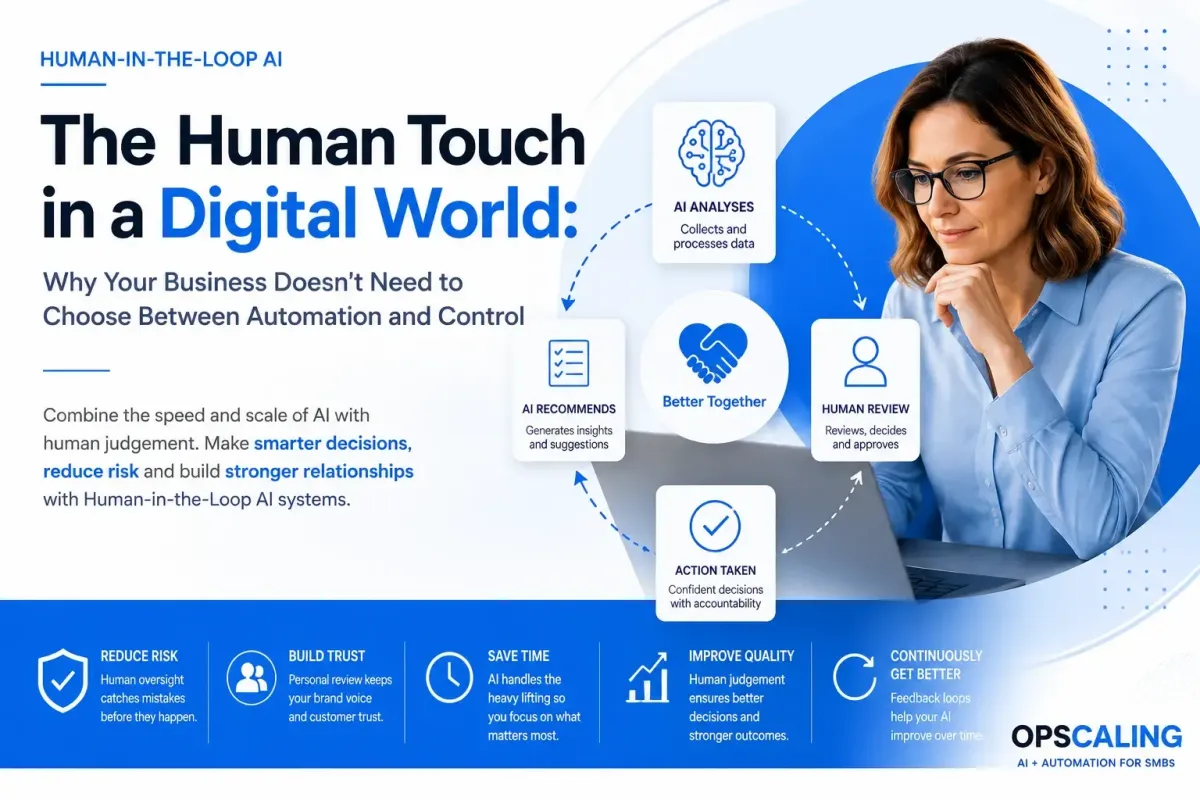
Human-in-the-Loop AI: Why the Future of Business Automation Still Needs People
If you run a business, you've probably felt the pull in two directions lately.
On one side: AI tools promising to save you hours a week on customer service, bookkeeping, marketing, and scheduling. On the other: a nagging worry that handing decisions to a machine means losing control over things that matter—your brand voice, a customer relationship, a refund that shouldn't go out automatically.
It's a genuine dilemma. And if you've spent any time online recently, you've probably seen the AI horror stories that make this anxiety feel entirely justified.
There's the airline chatbot that confidently promised a customer a refund, forcing the company to legally honor it. There's the car dealership whose AI was tricked into selling an SUV for $1. There's the law firm that used ChatGPT to write a legal brief—only to discover the AI had invented entirely fictional case law that didn't exist. And then there are the countless businesses whose automated marketing emails went out with bizarre, robotic, or outright offensive content.
For enterprises with deep pockets and dedicated PR teams, these are embarrassing moments. For your business? They're literal nightmares. A massive corporation can survive a PR blunder caused by an out-of-control AI. Your local business with a carefully cultivated reputation? Probably not.
This is why the smartest organisations aren't handing the keys of their business over to robots. Instead, they are adopting a strategy called Human-in-the-Loop (HITL) AI—an approach that resolves the tension between automation and control.
Instead of asking "should I automate this or not?", HITL lets you ask a better question:"Which parts of this task should AI handle, and where should a human step in?"
This is the framework that will separate businesses that successfully leverage AI from those that either avoid it entirely or automate too aggressively and pay the price.
What Human-in-the-Loop Actually Means (And What It Doesn't)
Let's cut through the buzzwords. Human-in-the-Loop (HITL) is refreshingly simple:the AI does the heavy lifting—drafting, sorting, analysing, recommending—and a person reviews or approves before anything final happens.
The AI might draft a reply to an angry customer, but you hit send. It might flag which five leads to call today, but you decide who actually gets the call. It might calculate a price change scenario, but no price moves without your sign-off.
Here's how it works in practice:
AI handles the routine: The system drafts emails, summarises data, or recommends the best lead to call next.
Your team steps in where it counts: A human reviews the AI's work, makes final decisions, adds the personal touch, and catches the errors that only real-world experience can spot.
The AI learns and improves: Every correction your team makes feeds back into the system, making it smarter for next time.
This is different from full automation (where AI acts alone with no review) and different from doing everything manually (where there's no AI assistance at all). HITL sits in the middle, and for most businesses, that middle is exactly where the value is.
A Simple Way to Visualise It
Think of it like having a super-fast, highly efficient intern. You wouldn't let an intern sign a $10,000 contract on their own, but you would let them draft it, research the numbers, and format it so all you have to do is read it and say, "Looks good, send it."
Or consider a head chef and a prep cook. The prep cook (AI) chops the vegetables and handles the tedious, repetitive tasks. But the head chef (your team) tastes everything and makes the final call before it leaves the kitchen. The chef's experience and judgment are irreplaceable, but they're freed from peeling potatoes.
A simplified HITL workflow might look like this:
text
Customer submits enquiry
 ↓
AI analyses information
 ↓
AI prepares recommendation
 ↓
Employee reviews recommendation
 ↓
Approve / Edit / Reject
 ↓
System completes task
The AI does most of the heavy lifting. The human provides judgment. This combination allows organisations to automate significantly more work while maintaining confidence in important decisions.
Why This Matters More for Smaller Organisations Than for Enterprises
Large companies can afford dedicated teams to build guardrails, run compliance reviews, and monitor AI systems around the clock. Smaller businesses can't. That's precisely why human-in-the-loop design matters so much here—it's a built-in safety net that doesn't require extra headcount.
Large organisations often have dedicated compliance teams, data governance departments, and specialist AI engineers. Most businesses rarely do. Instead, owners and managers wear multiple hats: sales, marketing, operations, customer service, and finance.
Here are the key reasons this approach fits smaller organisations particularly well:
1. You Don't Have Room for Costly Mistakes
A misfired autoresponder or an AI-issued refund that shouldn't have gone out can sting a lot more when you don't have a large customer base to absorb it. Because every decision matters, businesses generally cannot afford AI mistakes that:
Send incorrect quotations
Book incorrect appointments
Misprice services
Issue refunds incorrectly
Email the wrong customer
Approve incorrect discounts
Keeping a human in the approval chain catches these before they become expensive. Human review dramatically reduces risk.
2. Your Brand Voice Is Personal
Customers often choose a smaller business because it feels human. They want to interact with real people who understand their needs, not faceless automation. AI can draft the message, but you can make sure it still sounds like you.
Your biggest advantage over giant corporations is your ability to build personal relationships. AI can analyse customer data and draft a follow-up email, but it can't understand a client's nuance or add empathy to a difficult conversation.
3. Trust Is Your Biggest Asset
Every interaction—a reply to a complaint, a quote to a new client—is a chance to build or lose trust. Review steps mean nothing goes out that you wouldn't stand behind. With HITL, AI makes your team faster, but your people keep the work personal and trustworthy.
4. You're Resource-Constrained, Not Risk-Tolerant
The appeal of AI is getting time back, not gambling with your business. HITL gives you the time savings without asking you to gamble. If you have a team of five people, you don't have someone to spare for 40 hours a week of data entry or social media drafting. HITL allows your small team to output the work of 15 people, because the AI does 80% of the grunt work, and your team spends 20% of their time polishing it.
5. Built-in Quality Control
Smaller businesses win on quality and personal touch. If a customer asks a complex question about your plumbing services, an AI might give a generic answer. A HITL system lets the AI draft the response but allows your expert plumber to quickly edit it to include specific local codes or nuances.
The Challenge of AI "Hallucinations" and Why Confidence Matters
Large Language Models (LLMs) are probabilistic systems. Unlike traditional software, they don't retrieve fixed answers from a database. Instead, they predict the most likely response based on patterns learned during training. This makes AI remarkably flexible—and it also means it occasionally makes mistakes.
Examples include:
Misunderstanding customer intent
Misinterpreting uploaded documents
Producing inaccurate summaries
Incorrectly classifying enquiries
Hallucinating information
Missing important context
Giving answers that are technically correct but commercially inappropriate
For low-risk tasks, occasional mistakes may not matter. For high-value business decisions, they certainly do.
This is where the concept of AI confidence scores becomes important. Many AI systems produce an internal confidence score. Although users may never see it, confidence can determine whether AI acts automatically or requests human review.
Imagine an enquiry arrives: "I need someone to clean our conservatory and gutters."The AI may be 99% confident that this relates to exterior cleaning. Automation proceeds automatically.
Now consider: "I'm not sure whether you cover our type of property because we also have a detached workshop that needs specialist treatment."Confidence may fall considerably. Instead of guessing, the AI forwards the enquiry to a member of staff.
This is exactly how Human-in-the-Loop systems should operate. Instead of reviewing every AI action, businesses can review only the important ones.
Examples of when to require approval:
Quotation exceeds £5,000
Discount exceeds 20%
Confidence falls below 85%
AI detects customer dissatisfaction
Customer requests cancellation
Contract contains unusual clauses
Everything else proceeds automatically. This dramatically reduces workload while maintaining oversight where it matters most.
AI Is Excellent at First Drafts (Not Final Answers)
One of the biggest misconceptions is that AI should always produce the final answer. In reality, AI is often most valuable as a first-draft generator.
Examples include:
Writing quotations
Creating proposals
Drafting emails
Producing blog articles
Summarising meetings
Extracting CRM notes
Analysing customer conversations
Recommending workflow actions
Instead of replacing staff, AI removes the blank page. Employees then review, improve, and approve. This often reduces workload by 70–90% while maintaining quality.
A business leader from Glitch Ads perfectly captured this reality:"In software development, AI works really well for us because we have the expertise to challenge it... But in areas where we're less experienced... the challenge isn't capability. It's confidence."
Without a human to validate the output, you're essentially trusting a black box with your business decisions.
Where Human-in-the-Loop Shows Up in Everyday Operations
You don't need a complicated tech stack to benefit from this. Some of the most useful applications look like:
Customer Support
AI drafts a reply to a complaint or refund request based on order history—you approve, edit, or reject before it's sent.
Instead of letting a chatbot talk directly to frustrated customers, use an AI tool that acts as an "assistant" for your human reps. When a customer emails, the AI reads the email, checks your knowledge base, and drafts a suggested reply. Your rep simply reads it, clicks "Approve & Send," or tweaks a sentence first.
AI can also answer routine questions, retrieve knowledge articles, and summarise previous conversations. Support staff approve responses for more complicated enquiries. The result: faster response times with 100% human accuracy.
Sales and Lead Follow-up
AI ranks which leads are most worth calling today and drafts the outreach—you decide who to actually contact and when.
AI can analyse enquiries and recommend lead quality, likely budget, customer intent, urgency, product interest, and the recommended salesperson. Rather than assigning leads automatically, a sales manager simply approves the recommendation.
Cold emails still need a human touch. Use AI to write the first draft of a follow-up email to a hot lead. Before it sends, you jump in, add a quick personal detail, and let it fly.
Quotation and Proposal Preparation
Instead of manually producing every quotation, AI can analyse customer requirements, retrieve pricing, calculate options, prepare proposal text, and recommend upsells. A salesperson reviews before sending.
Financial Review and Accounting
AI reconciles transactions and flags anomalies at month-end—you approve the final numbers before they go to your accountant.
AI can also classify invoices, extract supplier information, and identify unusual spending. Finance teams review exceptions rather than processing everything manually.
Pricing Decisions
AI models how a price increase might affect margin and volume—you make the actual call on what to charge.
Content and Marketing
AI drafts social posts or email copy based on what's selling—you approve before anything goes out publicly.
AI can create newsletters, social posts, landing pages, advertisements, and blog articles. Marketing teams review before publication.
Contract Review
AI flags risky clauses in a vendor agreement—you decide what to push back on.
CRM Updates
Salespeople dislike updating CRM systems. AI can automatically summarise meetings, update opportunity notes, recommend next actions, populate custom fields, and categorise conversations. The salesperson simply confirms the summary.
Operations and Dispatch
A home services company used AI to handle 90% of its technician dispatch decisions automatically. Human dispatchers stepped in only for exceptions and complex routes, standardising the process and reducing guesswork. The result: faster, more consistent service.
HR and Payroll
TriNet's AI assistant helps businesses get fast, personalised answers to payroll and benefits questions. But the final strategic insights and coaching still come from experienced HR professionals—the human touch in the loop.
In every case, the AI removes the blank-page problem and the manual grunt work. The human makes the judgment calls.
AI as a Junior Employee: A Helpful Mental Model
A useful way to think about AI is as a highly capable junior employee.
Imagine hiring someone who:
Never sleeps
Reads thousands of documents instantly
Writes exceptionally quickly
Remembers every conversation
Learns new instructions rapidly
Would you allow them to sign contracts on day one? Probably not. You would supervise them. Review their work. Build trust gradually. Eventually, you would allow them to handle increasingly complex responsibilities.
Human-in-the-Loop AI works exactly the same way.
Progressive Automation
The best AI projects rarely automate everything immediately. Instead, businesses gradually increase AI responsibility:
Stage Description: Stage 1 AI makes recommendations only. Humans perform every action. Stage 2AI drafts responses. Humans approve. Stage 3AI completes low-risk tasks automatically. Humans review exceptions. Stage 4AI completes most routine work. Humans supervise dashboards. Stage 5: Humans become strategic decision-makers while AI performs the majority of operational work.
Most organisations are currently moving between Stages 2 and 3. This progressive approach ensures you never lose control while still capturing efficiency gains.
Human Feedback Makes AI Better
Here's the "secret sauce" of HITL: the system gets better because of your team.
Every approval, correction, and rejection teaches the organisation something. When your team corrects an AI's draft or overrides its recommendation, those corrections are tracked. The AI learns from those human judgments and improves the next time.
For example:
Employee changes quotation wording → AI instructions improve
Employee repeatedly corrects product classifications → Workflow logic improves
Employee identifies pricing errors → Business rules become more accurate
Over time, the system evolves. Rather than simply becoming "more intelligent," it becomes more aligned with how your business operates. You're not just buying a tool; you're building an asset.
As one AI builder for underwriting put it:"The right question is: how fast can your AI learn? Human in the loop was the unlock."
This creates a virtuous cycle: the more your team uses it, the more accurate and helpful the AI becomes.
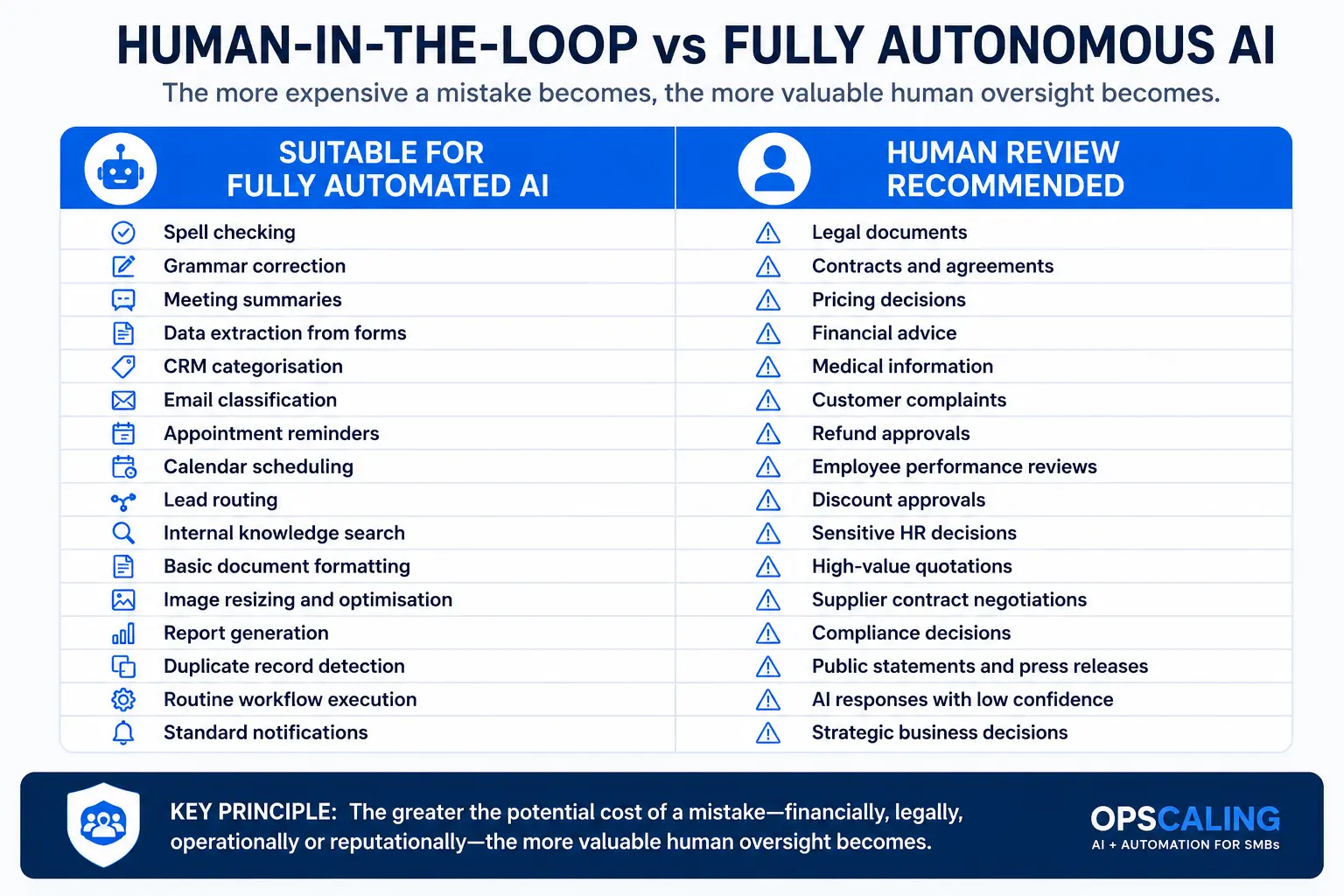
Human-in-the-Loop vs Fully Autonomous AI
There are situations where businesses can trust AI completely. There are others where they should not.
Fully AutomatedHuman Review RecommendedSpell checkingLegal documentsMeeting summariesContractsData extractionPricing decisionsCRM categorisationEmployee performanceAppointment remindersMedical informationInternal knowledge searchFinancial adviceLead routingCustomer complaintsEmail classificationRefund approvals
The more expensive a mistake becomes, the more valuable human oversight becomes.
Combining Traditional Automation with AI
One of the biggest mistakes businesses make is trying to replace deterministic workflows with AI.
Traditional automation remains exceptionally reliable. Examples include:
If invoice paid → send receipt
If appointment booked → send confirmation
If payment fails → notify accounts
If customer replies STOP → unsubscribe
These are deterministic processes. No AI is required.
Instead, AI should complement traditional workflows. For example:
text
Customer enquiry
 ↓
AI determines customer intent
 ↓
Traditional workflow executes correct process
 ↓
Human approves if required
 ↓
Automation completes
AI handles interpretation. Traditional automation handles execution. This combination produces systems that are both flexible and reliable.
Practical Example: A Local Service Business
Let's walk through a real-world example of HITL in action.
Imagine a plumbing company. A customer submits:
"We've got a leaking radiator upstairs and possibly a boiler issue."
The AI:
Extracts customer details
Identifies two potential services
Estimates urgency
Categorises as heating
Suggests engineer
Drafts response
Creates CRM opportunity
Because confidence is high, automation proceeds.
Now consider a different customer:
"We've recently renovated an old listed property and need advice about replacing multiple heating systems without affecting planning regulations."
The AI recognises uncertainty. Instead of guessing, it:
Flags the enquiry
Prepares a summary
Alerts a senior engineer
Waits for approval
Both customers receive faster service. Neither receives inaccurate advice.
What to Look for When Choosing HITL Tools
Not all "AI-powered" tools are built with this philosophy. As you evaluate options, look for:
1. Clear Approval Checkpoints
Can you see what the AI is about to do before it does it? Tools that act silently in the background are harder to trust. When looking at AI tools for your business, ask one simple question:"Can I turn off auto-send/auto-publish?"
If the tool forces you to let the AI act on its own, walk away. Look for platforms that use terms like "AI assist," "suggested replies," or "draft generation."
2. Explainability
Does the tool show its reasoning—why it flagged this lead, why it recommends this price—or just spit out an answer? Tools that can explain their decisions are easier to trust and correct.
3. Easy Override
Editing or rejecting an AI suggestion should be as easy as approving it. If correcting the AI feels like a fight, it'll get skipped, and mistakes will slip through.
4. Scoped Autonomy
Good HITL systems let you decide, task by task, how much independence the AI gets. Low-stakes tasks (drafting a first pass) might need less oversight than high-stakes ones (issuing a refund).
5. A Paper Trail
For anything touching money, legal terms, or customer commitments, you want a record of what was approved and by whom.
6. Confidence Thresholds
Can you set rules that automatically trigger human review when confidence is low? This is a powerful feature that balances efficiency with safety.
Tools like Help Scout, HubSpot, Grammarly, and even the free version of ChatGPT are inherently built for HITL—you generate the draft, you take the credit (and the responsibility).
Marketing Automation with HITL
Marketing automation is increasingly adopting Human-in-the-Loop principles.
AI can:
Score leads
Personalise email content
Generate follow-up messages
Recommend campaign adjustments
Identify buying signals
Marketing managers review recommendations before launching campaigns. This combines AI speed with human commercial judgment.
For example, AI might notice that a particular segment of your email list is engaging strongly with content about one product category. It could recommend shifting more email volume to that segment. But before the campaign goes out, a marketing manager reviews the recommendation, checks that it aligns with broader strategic goals, and approves.
How to Get Started Today
Ready to try it? Here's a practical first step:
Step 1: Pick One Repetitive Task
Choose something your team hates doing—something that takes more than 30 minutes a week. This could be drafting follow-up emails, summarising customer feedback, or classifying support tickets.
Step 2: Run It in Parallel
Have AI do the first pass (draft an email, sort a spreadsheet, summarise a document). Keep your team in the loop to review, correct, and finalise.
Step 3: Track the Corrections
What mistakes does AI make? Where does your team add value? This feedback is gold—it tells you how to improve your prompts and where the AI needs more training.
Step 4: Gradually Expand
As confidence grows, gradually allow the AI to handle more of the process. Start with low-risk tasks and work your way up.
Step 5: Establish Clear Approval Rules
Define when human review is required. For example:
Always review quotes over a certain amount
Always review customer complaints
Always review when AI confidence is below a threshold
Always review anything involving legal terms
The Future of Business Automation
Many people imagine AI replacing employees. A more realistic future is one where every employee works alongside multiple AI assistants:
Salespeople
Marketers
Engineers
Customer service teams
Finance departments
Operations managers
Each employee will increasingly delegate repetitive work to AI while focusing on judgment, creativity, negotiation, and relationship building.
Businesses that design these collaborative systems today will gain significant competitive advantages over organisations that either avoid AI entirely or automate too aggressively without sufficient oversight.
Best Practices for Implementation
If you are introducing AI into your business, consider these principles:
Automate repetitive work first. Focus on tasks that are time-consuming but don't require complex judgment.
Keep humans involved in high-value decisions. The more expensive a mistake would be, the more oversight you need.
Use confidence thresholds to trigger reviews. This balances efficiency with safety.
Design clear approval stages. Everyone should know when and how human review happens.
Record why humans override AI recommendations. This data is invaluable for improving the system.
Continuously refine prompts and workflows: AI systems improve with good feedback.
Combine AI with traditional deterministic automation. Don't replace reliable processes that don't need AI.
Gradually expand automation as confidence grows. Start small, learn, and scale.
The Bottom Line: Trust, Not Technology
The biggest challenge for businesses implementing AI isn't getting access to the technology. It's implementing it with confidence.
Human-in-the-loop AI gives you that confidence. It lets you leverage the incredible speed and data-crunching power of AI while keeping your people in control. It means you don't have to ask "Is AI accurate enough?" Instead, you can ask:"Is our team building a better system every day?"
Human-in-the-loop isn't a compromise or a stepping stone toward "real" automation—it's simply good design. It reflects something true about running a business: the goal was never to remove yourself from decisions, it was to remove yourself from the repetitive parts of those decisions.
Done well, HITL AI gives you back the hours you'd spend on first drafts, data-gathering, and routine analysis, while keeping your hand firmly on everything that actually shapes your business—your judgment, your relationships, and your brand.
Final Thoughts
Artificial intelligence is becoming one of the most valuable productivity tools available to modern businesses, but successful implementation is rarely about removing humans from the process. Instead, the greatest gains come from allowing AI to handle repetitive analysis, content generation, and administrative work while people remain responsible for judgment, customer relationships, and strategic decisions.
Human-in-the-Loop AI delivers the best of both worlds. Businesses benefit from faster workflows, lower operating costs, and improved consistency, while maintaining the oversight needed to protect customer experience, brand reputation, and commercial decision-making.
As AI capabilities continue to evolve, the organisations that thrive will not necessarily be those with the most automation. They will be those who know where AI should decide, where humans should decide, and how the two can work together seamlessly.
The businesses that benefit most from AI in the next few years won't be the ones that automate the most. They'll be the ones that figured out exactly where to keep a human—and where not to.
In the race to adopt AI, don't forget your greatest advantage: your people. They're not just "in the loop"—they are the loop.
Want to scale your business without losing your mind? Stop trying to automate everything. Start looking for AI tools that want to partner with you, not replace you.