

"Reverse Engineering" - A Search Engine Algorithm
For years, Google’s dominance has been attributed to a supposedly unbeatable algorithm—a technological moat built by brilliant engineers combined with automation and AI.
But what if that narrative is a myth? What if Google’s Search monopoly rests almost entirely on its exclusive access to user data—data that other search engines simply cannot obtain?
That may soon change, following a recent U.S. Department of Justice antitrust ruling.
This multi-year case against Google, launched during the first Trump administration, has concluded with a verdict that compels the tech giant to share user data with competing search engines. The goal is to foster true market competition by creating a level playing field.
In this blog post, we will explore how to reverse-engineer Google’s search engine—and reveal why it is far easier than you might imagine. The reason is simple: the approach it follows is not a magic algorithm, but rather the most logical method for ranking content such as websites.
The Big Secret Uncovered – Reverse Engineering the Algorithm
Google Search operates as a large-scale, user-driven ranking system within its organic, or “natural,” search results. Rather than functioning as an editorial engine that subjectively judges content quality, Google’s organic rankings emerge from the aggregated behaviour of millions of users interacting with search results over time. So, in organic search, rankings are not manually assigned. They are statistically derived.
Competing search engines can observe only what occurs within their own platforms: a query is entered, a result is clicked, and the session effectively ends. Google, by contrast, continues to observe user behaviour well beyond the initial click—across the entire website browsing journey that follows.
When a user clicks an organic search result, browses a website, returns to the search results, clicks another listing, compares multiple options, and ultimately completes (or abandons) a task, Google can observe each of these steps. It sees where users hesitate, where they return to, where they convert, and where they disengage entirely.
This extended visibility allows Google to measure each page against each search query. Over time, the system establishes an averaged behavioural outcome for every organic ranking position.
In effect, organic rankings are determined by users themselves, through their collective behaviour, rather than by any explicit editorial decision.
Without access to this feedback loop, no search engine—regardless of how advanced its automation rules and AI capabilities may be—can compete meaningfully in organic search.
Crucially, this behavioural data can be collected and applied in an anonymised, aggregated form, preserving individual privacy while still allowing search engine competition.
Google's Anti-Trust Hearing Results.
Initially, the US government was considering breaking up Google by splitting Chrome and Android into separate companies to prevent Google's data collection monopoly. In a democratic capitalist system, the government’s core economic duty is to create a genuine level playing field so competition can flourish and power does not overly concentrate.
Google was convicted of being a monopolist; however, in the final verdict, the judge noted the rise of AI search engines and decided against breaking up Google.
Instead, the ruling compels the tech giant to share crucial user data with competing search engines to foster true market competition by creating a level playing field.
In testimony, Google CEO Sundar Pichai warned that sharing search data would be a “disaster,” allowing competitors to “reverse engineer… our technology stack.”.
“Pichai called the suggestion a “disaster,” “far-reaching” and “extraordinary.” "If judge orders Google to give up its search index — the database that a search engine relies on — and the way it ranks that data, it would “allow anyone to completely reverse engineer, end to end, any part of our technology stack,” Pichai said. https://www.courthousenews.com/google-ceo-warns-feds-antitrust-remedies-could-crush-search-engine/
However, other competitor search engines had successfully argued that the user data is more important than Google’s existing algorithm to build effective search engines.
What Is Unknown So Far About the DOJ's Ruling?
While enforcing user data sharing in an anonymously aggregated form is a step toward fairness, the current approach leaves potential gaps:
Scope Unclear: Is data sharing limited to U.S. users or does it extend globally? Will European search engines gain access to user behaviour within Europe? Moreover, will the U.S allow American user data to be shared with European search engines?
Data Privacy: How does large-scale data sharing align with privacy regulations that require purpose limitation, transparency, and explicit user consent? For example, GDPR, CPRA, LGPD, PIPEDA, APPI, PIPA, PDPA, DPDPA and more.
Structural Imbalance: Although competitors may gain access to certain aggregated data, Google still retains its powerful tracking ecosystem—Analytics, Chrome, and Android continue feeding its proprietary data pipeline.
The Great Search Engine Illusion
Your ranking isn't determined by what Google thinks of your site. It's determined by what users think about your website. And Google is the only company that gets to watch what users think
The tech industry wants you to believe that search supremacy comes from brilliant algorithms, AI breakthroughs, and engineering genius that mere mortals can't replicate. We've been sold a myth for decades. Bing, DuckDuckGo, and a dozen start-ups have built competent search algorithms, but they have failed to compete with Google's monopoly.
But here's the truth: Building a basic search engine is surprisingly simple, but it will never be competitive without the aggregated user data that Google has. The code to crawl websites, index content, and return relevant results that rely on user ranking data.
Here is a Python coding example of the concept.
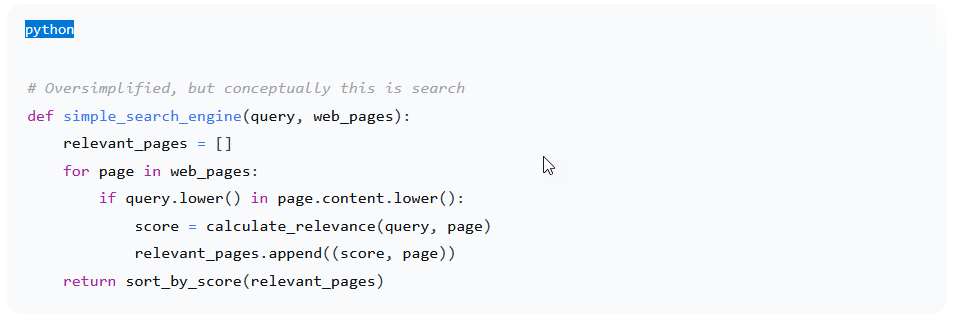
This code demonstrates the simple core idea of how search engines work at the most basic level: Imagine you're looking through a stack of documents (or webpages) for a specific word or phrase.
The code does exactly that:
It takes what you're searching for (like "digital TV")
It goes through each document one by one
It checks if your search words appear in the document.
If they do, it gives that web page a "relevance score" (like how well it matches)
Finally, it sorts the webpages so the best matches appear first
The code shows the fundamental concept: search = finding + ranking. But the real magic—and Google's competitive advantage—isn't in this basic matching. It's in everything that happens after the match: understanding what users really want, learning which pages actually satisfy people, and applying user behaviour to decide which results deserve to rank highest. Overtime data of statistical significance is established, making it easy to sort pages like products or services from best sellers downwards.
The Real Magic Happens AFTER the Click
Bing, DuckDuckGo, and many others have built competent search algorithms. Yet none come close to Google's results. Why? Google's unbeatable advantage isn't its search algorithm—it's what happens after users leave the search results page.
Think about it:
You search for "best running shoes for flat feet"
Google shows 10 results
You click #3, spend 47 seconds on this website, and hit back on your browser.
You click #7, spend 12 minutes reading, and bookmark the page. You later return and make the purchase.
You never return to Google
Traditional search engines see steps 1-2. Google sees what happens on the websites that you click through to from Google.
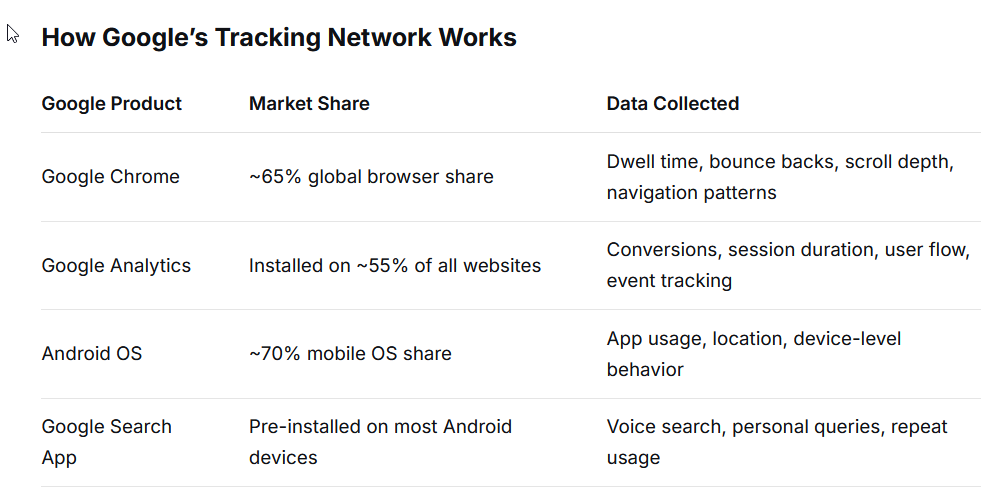
Here's how Google tracks what happens after the click:
Google has a range of methods from cookies to hashed first-party data. Let's take a look at the main ways.
1. The Chrome Browser Surveillance System
More than 65% of web traffic flows through Chrome. Google sees:
How long you stay on a website after you click on the website page link from within Google
Whether you scroll or just bounce
What you click next (internal links vs. back button)
If you return to search (and how quickly)
When you hit the back button immediately (also known as “pogo-sticking”)
Whether you return to search or move on satisfied
2. Google Analytics: The Trojan Horse
55% of websites—including Amazon, Airbnb, and your local bakery—run Google Analytics. This gives Google:
Exact dwell times
Conversion events (purchases, sign-ups, downloads)
User flow patterns
Engagement metrics (scroll depth, interactions)
Returning visits
3. Android's Mobile Monopoly
70% of mobile searches happen on Android devices, where Google controls:
App usage patterns
Location data
Cross-app behaviour
4. The Conversion Loop
This creates Google's unbreakable competitive advantage:
Better Data → Better Rankings → More Users → Better Data
Other search engines face a chicken-and-egg problem:
They need user behaviour data to improve results
They need good results to attract users
They can't get #1 without #2, and can't get #2 without #1
Google solved this decades ago by spreading its tracking tentacles across the entire web ecosystem. This post-click behavioural data creates a self-reinforcing feedback loop that no competitor can match:
The Original Goals of the World Wide Web as defined by the Inventor
The inventor of the World Wide Web, Sir Tim Berners-Lee (a British computer scientist working at CERN in Switzerland), didn't just create a technology; he embedded a powerful philosophy into its design.
His philosophy for the Web centred on creating a more open, egalitarian “information space” than any traditional, offline marketplace or media system, with low barriers to entry and room for intense competition and innovation. This vision emphasised universality, non‑discrimination between users or sites, and the idea that no single actor should control who gets to publish or who gets to be heard.
Openness and a level playing field
The Web was conceived as a universal space where anyone could publish and link information without asking permission from gatekeepers such as publishers, broadcasters, or large companies.
Berners-Lee argued that the Web should not favour particular hardware, software, companies or nations, reflecting a commitment to “no walls” and to equal technical treatment of all participants.
Better than offline markets
In contrast to offline markets and media, which often privilege incumbents with capital, distribution, or political influence, the Web’s core design allows a small new site to be just one click away from the largest institutions.
This architecture weakens traditional intermediaries: instead of having to secure shelf space, broadcast slots, or print distribution, individuals and small groups can reach global audiences directly.
Competition and innovation by design
Berners-Lee’s choice to make the Web standards open and royalty‑free was explicitly intended to prevent any company from monopolising the basic infrastructure, encouraging many browsers, servers, and services to compete and evolve.
Decentralisation and user empowerment
The Web was designed as a decentralised network of documents and servers, so control is spread among millions of site owners instead of a few centralised authorities, echoing a political and social preference for distributed power.
Ethical and civic aspirations
From early on, Berners-Lee framed the Web as a public good that should support democratic human rights, free expression, and open scientific and cultural exchange, rather than just commerce.
His later advocacy for net neutrality and for an open, interoperable World Wide Web reflects continuity with the original philosophy: technical design choices are meant to preserve a fair, competitive environment where no one can easily lock others out.
The Origins Back Story of Google.
Google’s origins lie in academic research conducted at Stanford University, where Larry Page was studying computer science.
As part of his studies, Larry Page was required to review multiple academic papers for each exam. Over time, he noticed a consistent pattern: one or two sources were invariably more authoritative than the rest. This observation was reinforced by citation behaviour—these same papers were referenced far more frequently by other authors. Crucially, he realised that academic papers could be ranked objectively by analysing how often they were cited by other authoritative sources. Citations, in effect, acted as a measurable signal of trust, authority, and relevance within academic literature.
Page also observed that this pattern extended beyond individual papers to the websites hosting them. Institutions and authors publishing high-quality research tended to attract more inbound links from other websites—what would later be known as backlinks.
He then extended this insight to the World Wide Web. Websites, like academic papers, formed a network of references, with links functioning as endorsements between sources.
By counting and weighting these links—giving greater importance to links from already authoritative websites—it became possible to determine which sources were most trusted across the web. This insight formed the foundation of PageRank, an algorithm that treated links as referrals rather than mere navigation tools.
PageRank fundamentally shifted search from simple keyword matching to authority-based ranking, allowing content to be ordered according to collective endorsement rather than superficial relevance signals. This conceptual leap would ultimately become the core innovation behind Google’s rise as the dominant search engine.
Early Challenges and the Dot-Com Era
Google rapidly became the most effective search engine due to the superiority of PageRank.
However, during the dot-com era, Google was operating primarily on venture capital and was not yet profitable. At the same time, competing search engines began to replicate link-based ranking models.
This period also saw the rise of search spam. Manipulative tactics such as artificial link creation emerged as bad actors attempted to exploit PageRank. Google lacked sufficient resources at the time to fully combat large-scale spam, placing the company in a precarious position.
Google came close to being acquired by Yahoo, which was a significantly larger company at the time with multiple established revenue streams.
The Introduction of PPC and Profitability
A turning point came when a company called Overture pioneered pay-per-click (PPC) advertising.
This model allowed advertisers to pay for placement in search results, and the platform was effectively “rented” to search engines such as Google and Yahoo. Paid listings appeared above organic (natural) search results. This made Google profitable overnight as it could monetise its search engine.
Yahoo soon acquired Overture, while Google chose a different path by building its own PPC platform: Google AdWords (now Google Ads). This decision proved transformational. Google now also had the capital to invest in advanced spam protection, removing the impact of artificial backlinks.
Google Analytics and Competitive Advantage
Google’s data advantage did not emerge by accident—it was engineered.
In 2005, Google acquired a company called Urchin, which was subsequently rebranded as Google Analytics and released as a free website analytics solution. This single decision led to near-universal adoption across the web.
Website owners gained access to enterprise-grade reporting at no cost, including traffic sources, page views, user journeys, events, form submissions, and e-commerce transactions. For publishers and businesses, this represented a major leap forward in website measurement and optimisation.
At the same time, Google gained something far more valuable.
By embedding its analytics script across millions of websites, Google obtained unprecedented visibility into what users did after clicking on organic search results. This closed the loop between search intent and real-world outcomes—allowing Google to observe engagement, abandonment, conversions, and behavioural patterns at internet scale.
This data materially enhanced Google Search and created a competitive advantage that no rival search engine could realistically replicate.
Even if competitors developed comparable tracking scripts, they faced a near-impossible distribution challenge: persuading millions of independent website owners to adopt their tools. No other search engine achieved this level of penetration. Microsoft Bing came closest, but still at a fraction of Google’s scale.
Over time, Google Analytics became a foundational pillar of Google’s broader data ecosystem—feeding not only Search, but also advertising optimisation, attribution modelling, and behavioural analysis. The result was a self-reinforcing loop: better data produced better rankings and ads, which attracted more usage, generating even more data.
Other technology companies also deploy tracking scripts on websites, but these are typically present on only a small subset of the web. Their data coverage is fragmented, inconsistent, and insufficient for large-scale ranking systems.
In 2008, Google further entrenched its advantage by launching Google Chrome. With Chrome, Google gained direct visibility into user behaviour even on websites where Google Analytics was not installed—extending its observational reach beyond voluntary tracking implementations.
Together, Google Analytics and Chrome transformed Google from a search engine that indexed content into a company that could systematically observe user behaviour across the internet—an advantage that remains central to its dominance today.
Learning How The Google Algorithm Works:
If you use ChatGPT or a search engine to learn more about Google’s algorithm, you’ll likely encounter a “consensus” that’s incorrect. The common belief is that Google relies on hundreds of signals to create a highly complex algorithm. However, what we’re going to show is that while search engines like Google and Amazon do consider hundreds of signals, only a few key metrics truly determine rankings—the rest serve mainly as tie-breakers, correlating statistics, and stabilisers. reinforcement or as a means to rotate the algorithm to make it harder to decipher. Plus, other search engines can do most of the other stuff that Google can do - just not the most important thing of all (user tracking)
For different industries, Google tracks key "success" signals:
E-commerce: Purchases, add-to-cart events, average time on page (website dwell time).
Service Businesses: Form submissions, time on page, and click-to-call.
News Sites: Time-on-page, return visits, scroll depth
Social Media: Time-on-page (Dwell time)
Blogs: Session duration, newsletter signups, content upgrades, social shares
Videos: Watched the whole video, shared the video and liked the video.
Personalisation: Google will sometimes adjust the listings based on factors such as your location. If you enter the search term "Private Dentist", it will show more local service providers.
The easiest way to prove how the Google algorithm works is by starting with e-commerce websites—those that sell physical or digital products online.
Testing Amazon's Search Engine Algorithm as Proof:
Amazon, as a specialist product-based search engine, accounts for over 50% of all online transactions. The ranking algorithm of Amazon is relatively simple. Like Google, there are hundreds of ranking signals—but one or two outweigh all others combined.
When products generate a high number of sales over the last month, they are ranked by the most frequently purchased products. Organic rankings on Amazon are influenced by factors including:
Conversion rate (searches to purchases)
Sales volume and sales history
Volume and quality of reviews
For new products, add-to-cart activity and time spent on the product page.
Amazon is effectively sorting products that sell most frequently for each respective search term. This is better for the search engine user, and it is better for Amazon.
Sometimes, Amazon’s merchandising—such as “Amazon Recommended”, “On Sale”, or the promotion of a new product—can influence its primary ranking signals within organic results. Additionally, for keywords where products have a low number of sales over the past month, conversion rate will not always be used as the primary (or only) ranking signal. In these cases, Amazon may vary results to surface products with different product attributes, such as price points or delivery timeframes, to provide a range of options.
However, the primary ranking signal remains conversion rate. This makes Amazon’s algorithm relatively straightforward and most observable in high-sales-volume product categories, where Amazon generates the majority of its revenue.
At the top of the search results page, you will typically see advertisements, also known as Sponsored Listings (Amazon Ads). These placements are paid for by advertisers and appear above the organic listings. When you scroll past the sponsored ads, you will see products sorted by organic ranking signals. Unlike Google, which always lists results vertically from top to bottom, Amazon can rank products horizontally(from left to right) or vertically.
Demo: Amazon's Search Engine Ranking Algorithm
Video Transcript below:
Visit Amazon, and enter the search term “Single Mattress” into the search bar.
Then, scroll down below the sponsored listings adverts:
For the product ranked number one, we can see it has:
Over 2,000 sold in the past month
Over 3,000 feedback ratings, with an average of 4.3 out of 5
For the product ranked number two, we can see it has:
Over 1,000 sold in the past month
Over 600 feedback ratings, with an average of 4.3 out of 5
This is a newer product.
For the product ranked number three, we can see it has:
Over 1,000 sold in the past month
4,700 feedback ratings, with an average of 4.1 out of 5
For the product ranked number four, we can see it has:
Over 800 sold in the past month
Over 6,300 feedback ratings, with an average of 4.1 out of 5
This is an older product, as indicated by the higher number of feedback ratings and the 'Best Seller' label. The organic ranking of this product is clearly decreasing over time.
For the product ranked number five, we can see it has:
Over 200 sold in the past month
Over 20 feedback ratings, with an average of 4.0 out of 5
An Example of Udemy's Search Engine Ranking Algorithm
When a user performs a search on Udemy, historical sales volume and recent conversion rate are the dominant ranking signals, outweighing most other factors. Courses that consistently convert browsers into purchasers are rewarded with higher rankings, as this directly aligns with Udemy’s commercial objective: maximising marketplace revenue while surfacing content most likely to satisfy user intent.
As with Amazon, Udemy’s merchandising strategy may influence organic rankings; however, when running a wide range of searches across different products, the number one ranking signal is consistently conversion rate (click-to-purchase).
Google E-commerce Search Engine Algorithm
Product-based search engines provide the clearest and most observable model for understanding how Google Search works in practice.
Platforms such as Amazon —which accounts for over 50% of global online transactions—and Udemy operate as search engines where ranking logic is easily observable. In both cases, products are primarily ranked by conversion rate, derived from aggregated user behaviour rather than editorial judgement.
At a fundamental level, Google applies the same principle..
Google is doing what other product-based search engines—such as Amazon and Udemy do: primarily ranking products by conversion rate, with rankings determined by aggregated user behaviour.
Unlike Amazon or Udemy, which observe behaviour only within their own platforms, Google tracks users across the wider internet. From a behavioural perspective, this allows Google to treat the whole World Wide Web as a single website. As users move from search results to external websites and back again, Google can observe outcomes at scale and aggregate those signals into organic (“natural”) rankings—while serving paid advertisements alongside them.
In an e-commerce context, this logic is straightforward.
If one product page converts 5% of visitors into buyers for a given search term, and another converts only 1%, the higher-converting page will outperform the lower-converting page in organic rankings over time. Here, a “conversion” represents the successful completion of the user’s objective—typically a purchase
To illustrate this numerically:
If two websites each receive 100 clicks from Google for the same keyword, but one generates 5 sales while the other generates only 3, the ordering of those results becomes statistically obvious. Google does not need to “decide” which page is better—it simply observes which outcome users collectively prefer.
Website Goals
Not all searches are designed to produce a direct “conversion” in the form of a purchase. Instead, Google optimises different result types based on the intended outcome of the query and the behavioural signals associated with success for that category.
Informational queries (e.g. “how to fix a sink”)
Success is measured by whether the user finds the answer and does not return to the search results. Low pogo-sticking, sufficient dwell time, and task completion indicate a successful result.
Navigational queries (e.g. “Facebook login”)
Success is binary: the user reaches the intended destination quickly. Rankings are stable because intent is unambiguous.
Transactional queries (e.g. “buy iPhone 15”)
This is where the e-commerce analogy fits best. Pages that convert a higher percentage of users into purchasers outperform those that do not. Conversion rate is the clearest signal of relevance and satisfaction.
Types of Non-eCommerce Content
Lead Generation Websites
For service-based businesses, success is measured through actions such as contact form submissions, phone calls, chat interactions, appointment bookings, and meaningful dwell time. A page that consistently drives qualified enquiries and downstream conversions is more valuable than one that generates superficial traffic.
Image Content
For image-based searches, success is measured through engagement signals such as image clicks, expansions, saves, downloads, and time spent interacting with image results. Images that consistently attract interaction and lead to downstream engagement are promoted.
Video Content
For video results, performance is driven by metrics such as click-through rate, watch time, percentage viewed, completion rate, and repeat views. A video that retains users and drives continued engagement will outperform one that is abandoned early.
News & Journalism Content
For news queries, freshness is critical, but engagement still determines quality. A news article that retains readers for five minutes is objectively stronger than one abandoned after ten seconds. Early ranking signals rely heavily on publisher authority, historical performance, and real-time user engagement patterns.
Informational & Educational Content
For guides, tutorials, and knowledge articles, success is measured by dwell time, scroll depth, content completion, return visits, and downstream navigation to related resources. High-retention educational content signals relevance and expertise.
Social Media & Community Content
For forums, social posts, and community discussions, ranking signals include reply volume, conversation depth, engagement rate, thread longevity, and repeat user participation. High-quality discussions that sustain attention and interaction are prioritised.
Academic & Research Content
For scholarly content, success is measured by citations, downloads, references from trusted institutions, time spent reading, and cross-linking between academic sources. Authority and verification signals carry higher weighting than raw engagement.
Developer Documentation & Technical Content
For technical documentation, success is measured by dwell time, code-copy events, documentation navigation depth, external references, and developer return visits. Practical usability and task completion signals dominate ranking relevance.
Audio & Podcast Content
For audio search results, ranking signals include listens, completion rate, average listen duration, replays, and subscriber growth. Content that sustains listening and drives follow-on engagement ranks higher.
Navigational & Utility Content
For login pages, dashboards, and tools, success is measured by successful task completion, low bounce-back-to-search rates, and repeated direct visits. The primary ranking signal is whether users complete their intended task without returning to search.
Local & Maps-Based Content
For local results, success is measured by calls, direction requests, bookings, dwell time on listings, and post-click engagement with business profiles. Verified real-world actions signal quality and relevance.
Across all categories, Google adapts its optimisation target to the goal of the search. The algorithm does not judge content subjectively; it evaluates outcomes by quantifying and aggregating data to get average scores. In effect, Google’s algorithm functions as a mirror of collective human preference—reflected through behavioural data at a scale that only Google can collect and aggregate.

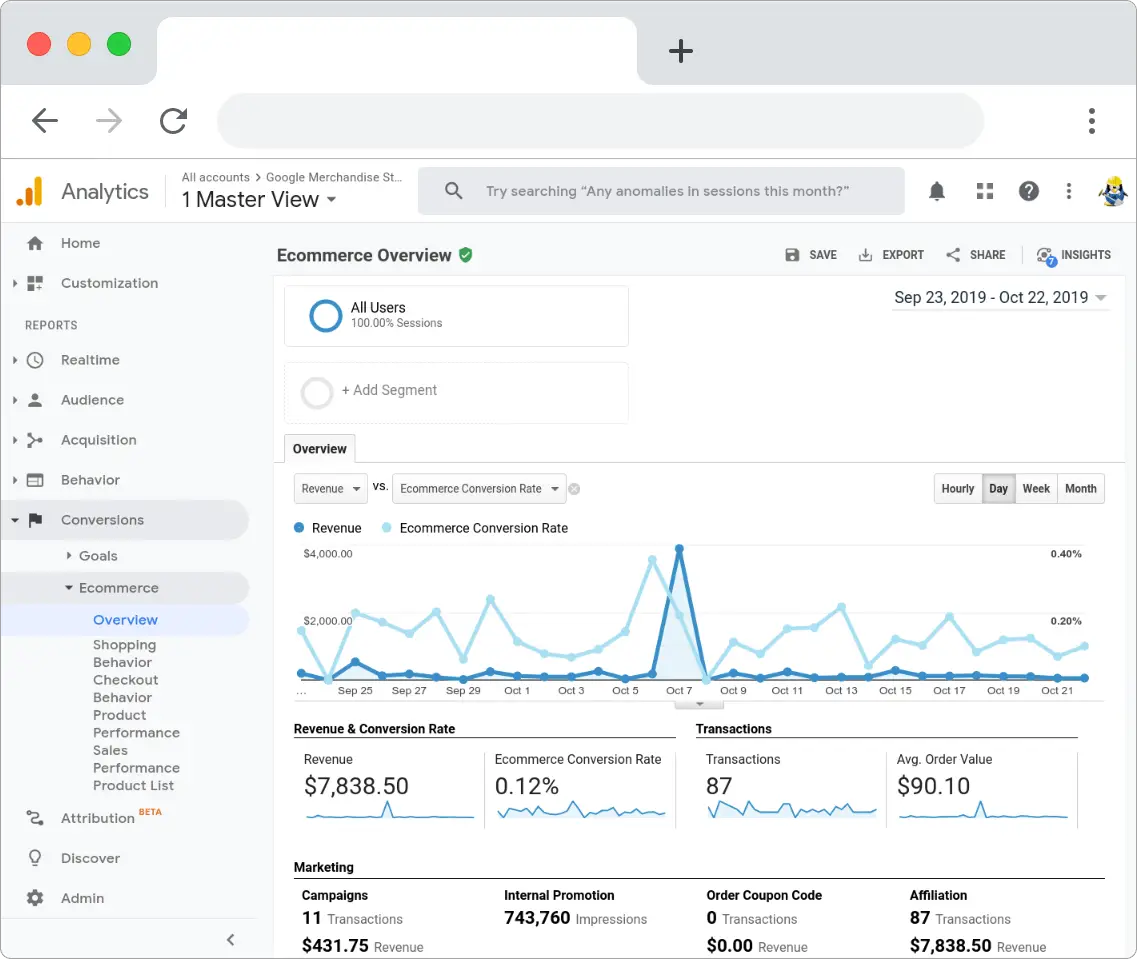
The two screenshots above and below show Google Analytics data, which operates on the vast majority of websites worldwide. This example uses demo data from an e-commerce company that sells products
The data reveals key sales metrics—such as top-selling products, revenue, number of purchases, and conversion rates. This information forms a valuable resource, enabling Google to identify the most successful products for every search term in its search engine. In turn, this allows Google to organise products by best sellers, similar to how Amazon ranks products on their own website by popularity for each search term. Google's tracking essentially turns the whole World Wide Web into a single website, allowing Google to rank each page.
Google can rank pages by conversion rate or similar engagement signals because it tracks user behaviour across websites through tools such as Google Analytics and the Chrome browser.
Symptoms of the Problem
Google has maintained a dominant position in search not solely through algorithmic superiority, but by leveraging a cross-site behavioural tracking network that competitors cannot replicate. This network—composed of Google Analytics, Google Chrome, Android, and Google Tag Manager—allows Google to observe user behaviour after they leave the search results page, creating an insurmountable “data feedback loop” that violates principles of fair competition.
Essential Facility Doctrine
Google’s tracking infrastructure constitutes an “essential facility” that:
Cannot be reasonably duplicated by competitors
Is necessary for effective competition in search
Is controlled by a dominant player who restricts access
Data Feedback Loop as Barrier to Entry
The loop operates as follows:
Better Rankings → More Traffic → More Behavioural Data → Improved Algorithm → Better Rankings
New entrants cannot access the behavioural data portion, preventing them from competing on relevance.
Tying and Self-Preferencing
Websites feel compelled to use Google Analytics for SEO insights
Android devices preferentially route searches to Google
Chrome promotes Google Search while tracking competitors’ users
Possible Solutions to Democratise the Market:
A) The U.S. government’s proposal for Google to share data with competing search engines is a good starting point. However, this arrangement might apply only to other major American tech companies. It would also need to comply with GDPR and other local privacy laws. Moreover, it remains unclear which data would be shared—for instance, would a competitor search engine receive post-click data for searches made on its own platform, or would it gain access to aggregate search data from all competing search engines?
B). An open-source public tracking utility—a single, standardised script that collects anonymised tracking data from all search engines and post-click data from all websites, with strict privacy safeguards. Aggregate metrics would then be made available to all licensed search engines on equal terms. This would improve competition, as well as the implementation of GDPR, by protecting individual user privacy from large data brokers such as Google.

How the Universal Tracking System Should Work
A. The Tracking Script
Name: universal-search-data.js
Hosted by an international body such as the ICO (Information Commissioner's Office) and maintained under nder applicable data-protection and privacy regulations.
The script itself could be made open source to ensure transparency. Development and improvements could be contributed by anyone; however, all changes would need to be reviewed, accepted, and formally approved by the governing authority and script author, such as the ICO or EU GDPR.
Mandated for: All commercial websites operating within designated markets that must be GDPR-compliant and use the legally approved method of user tracking. All other methods of tracking will be banned - this is the only legal method. There is a range of options for other search engines to access the data, which we cover below.
Data collected (anonymised and aggregated):
Dwell time on page
Conversion events (purchases, sign-ups, calls)
Scroll depth
"Back-to-SERP" events
Navigation paths within the site
B. The Search Query Attribution
When a user clicks a search result:
Original: https://example.com/query=running+shoe
Becomes: https://example.com/product?src=search&engine=google&query=running+shoes
All search engines must pass standardised parameters that contain the search term to get back website user performance data in return.
The tracking script records referrer and query attribution
Search engines must pass standardised parameters containing the search term in order to receive post-click performance data in return.
C. The Government Data Marketplace
Database: Centralised, secure repository of aggregated metrics
Access: Equal, licensed API access for all compliant search engines
Metrics provided:
Industry averages (search term and landing pages)
Page-specific performance vs. industry average
Time-based trends (weekly/monthly)
Geographic and device breakdowns (aggregated)
Pogo-sticking metrics using the browser back button
D) Ranking Signals Data
Simple, Transparent Formula:
Ranking Score = (Page Conversion Rate) ÷ (Industry Average Conversion Rate)
Example Calculation:
For search "wireless headphones":
Industry average conversion rate: 1.5%
Page A conversion: 7.5% → Score: 7.5/1.5 = 5.0
Page B conversion: 4.5% → Score: 4.5/1.5 = 3.0
Page C conversion: 1.8% → Score: 1.8/1.5 = 1.2
Page D conversion: 0.9% → Score: 0.9/1.5 = 0.6
Result: Page A ranks highest, Page D lowest.
E) Implementation Steps
Phase 1: Legislation & Standards
Data collection protocols
Privacy safeguards (GDPR+/CCPA+ compliant)
API specifications
Create a certification for search engines that they must comply with
Phase 2: Technical Rollout
Develop an open-source tracking script
Create a secure data pipeline (encrypted end-to-end)
Build query parameter standards for search engines to pass and receive data back
Establish an independent oversight board
Phase 3: Transition Period
6-month phase-out of private tracking scripts (Google Analytics, Facebook Pixel, etc.)
Gradual implementation by website size (the largest are the first to be mandatory)
Search engines must support the new protocol.
F. Privacy & Security Protections
Data Minimisation Principles:
No personal identifiers collected
Minimum data retention (e.g. 360 days aggregate, 180 days raw)
Differential privacy techniques applied
Local processing where possible (edge computing)
User Controls:
Browser setting: "Participate in search improvement"
Per-session opt-out capability
Clear disclosure of data usage
Independent audit rights
An open source framework that provides transparency in how data collection is done. The government or other bodies would approve or reject suggested changes to the script
Security Measures:
End-to-end encryption
Regular penetration testing
Data breach notification requirements
G. Economic & Competitive Impact
Levelling the Playing Field:
New entrants: Can launch with a quality ranking immediately
Incumbents: Must compete on algorithm innovation, not data hoarding
Businesses: SEO becomes about actual user satisfaction, not gaming systems
Consumers: Better search results across all engines to make comparisons
H. Addressing Potential Concerns
Q: Won't this create a government surveillance apparatus?
A: The system collects far less data than current private surveillance. Data is:
Anonymised at collection
An open source solution that is easy to prove it works as stated.
Aggregated before storage
Only accessible as statistical averages
Subject to strict judicial oversight
Q: How to prevent manipulation
A: Multiple safeguards:
Statistical anomaly detection
Minimum sample sizes for metrics
Cross-validation with other signals
Penalties for attempted gaming
Q: International applicability?
A: Designed as an open standard for global adoption
Can be implemented by treaty organisations (EU, OECD, UN, WEF)
GDPR Certified Solution to protect privacy and promote competition
H. Technical Architecture
Key Components:
Client-side library: Lightweight JavaScript (< 50KB)
Edge processing nodes: Regional data aggregation
Central clearinghouse: Statistical analysis
API gateway: Rate-limited access for search engines with billing based on usage
Audit system: Transparent data flow monitoring

Legislative Language Highlights
Key provisions needed:
Universal Search Data Collection Act: Mandates the use of a standardised script
for data privacy compliance.Search Competition Restoration Act: Prohibits private post-click tracking
Digital Transparency Amendment: Requires search source disclosure in URLs
Public Algorithmic Accountability Act: Mandates ranking transparency
The Benefits:
The "one script" solution creates what antitrust law calls an "essential facilities doctrine" application for the digital age. By making post-click engagement data a public utility, we:
A more comprehensive dataset than even Google maintains.
Alleviate Google's data monopoly without breaking the company
Create genuine competition in search for the first time in 25 years
Improve user privacy through centralised, regulated data collection
Enable innovation in search interfaces and algorithms
Promote Democratic principles to make capitalism work for the majority.
This is not about government overreach—it's about correcting a market failure. When one company controls the feedback loop essential to competition, intervention becomes necessary to restore fair markets. (Hence the intervention by the American Department of Justice).
The beauty of this solution is its simplicity: One script to rule them all, one database, equal access for everyone. The best search engine wins based on merit, not on who owns the surveillance network. It will also have privacy restrictions to prevent tracking IDs from being matched to personally identifiable information.
Approaches to Implementing the Tracking Technology.
Here are two primary implementation paths. The first is to provide anonymised raw datasets, enabling each search engine to calculate its own final ranking scores independently. The second is to have the tracking server that operates the script compute the user-signal metrics centrally and return a pre-calculated ranking score—an approach that is inherently more privacy-preserving.
Under the second model, ranking logic can be applied either through predefined algorithm presets or via an interface that allows search engines to build and customise their own weighting models.
A phased model could be adopted, starting with broader access to raw data and progressively reducing granularity over time to a predefined standard. This standard would reflect the most common and accepted methods for calculating ranking scores, including the relative weighting of each signal.
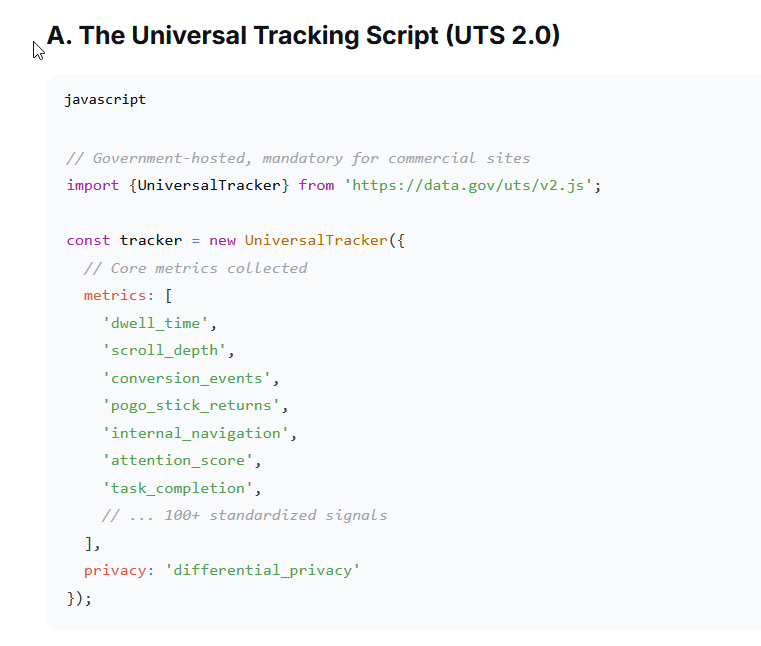
The second option is effectively a government-operated marketplace that search engines can connect to. It is more privacy-preserving, as the ranking algorithm is calculated on government-controlled servers rather than by the search engine itself. The output provided to the search engine would be a single numerical ranking score.
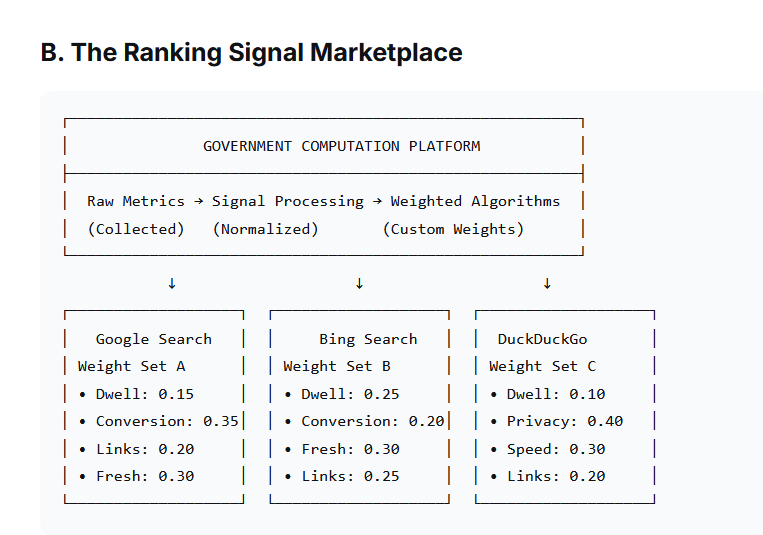
Tier 1: Pre-set Algorithms Examples
This is the simplest approach, which allows a search engine to use an existing preset algorithm. Here are some very brief examples for illustratory purposes.
"Balanced" (Default): • Conversion Rate: 30% • Dwell Time: 25% • Return Rate: 20% • Scroll Depth: 15%
"News & Media": • Dwell Time: 50% • Return Visits: 30% • Scroll Depth: 10 % • Sharing: 10%
"E-commerce": • Conversion: 70% • Reviews: 10% • Add-to-Cart: 10% • Dwell: 10% "
Tier 2: Custom Weight Builder
A web interface where users can calculate their own algorithm.
Drag and drop ranking factors
Set percentage weights (must sum to 100%)
Create and save custom presets
Share algorithms publicly
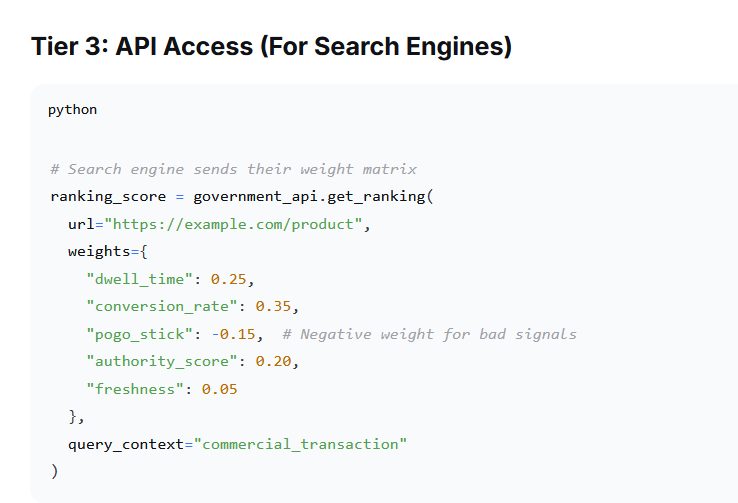
This setup is effectively a headless search engine: a search platform in which the core search logic and index are exposed via APIs, while the user interface is left entirely to individual search engines to design and implement.
The 100+ Standardised Raning Signals (Categorised)
Engagement Metric signals
Average Dwell Time
Scroll Depth Percentile
Attention Heatmap Score
Video Completion Rate
Interactive Element Usage
Return Visit Frequency
Bookmark/Save Rate
Print/PDF Generation
Text Selection Patterns
Mouse Movement Entropy
Conversion Metric signals
Purchase Conversion Rate
Lead Form Completion
Phone Call Duration
Chat Initiation Rate
Appointment Booking
Newsletter Signups
Account Creation
Demo Requests
Free Trial Starts
Content Downloads
Quality Signals
Pogo-Stick Return Rate (negative)
Complaint/Refund Rate (negative)
Support Contact Frequency (negative)
Positive Review Ratio
Content Update Frequency
Error/404 Rate (negative)
Load Speed Percentile
Mobile Responsiveness Score
Accessibility Compliance
Security/SSL Score
Authority Signals
Verified Expert Contributions
Academic Citation Count
Government Source Verification
Professional License Status
Industry Award Recognition
Media Mention Quality Score
Cross-Platform Consistency
Age/Domain Authority
Update Velocity
Fact-Check Status to establish the truth
The Weighting Marketplace
Instead of providing just raw data, the government system becomes a ranking signal computation platform where search engines can:
Access 100+ standardised engagement signals
Assign their own weights to each signal
Receive a computed ranking score in real-time
Compete on algorithmic intelligence rather than data access. Google have 25+ years of experience, so rival search engines need a level playing field to catch up.
Level Playing Field:
Startups: Same signal access as Google, can innovate on weighting
Specialised Engines: Focus on verticals (medical, legal, academic)
Regional Engines: Optimise for local languages/cultures
Privacy Engines: Use privacy-preserving signal subsets
The Result: Algorithmic Democracy
Instead of one company's secret algorithm determining what humanity sees, we create:
Transparent competition in ranking intelligence
User choice in what values are prioritised
Equal data access for all innovators
Privacy by design in data collection
Specialised search for different needs
The open-source tracking script builds the tracking infrastructure and computation platform.
Private companies and users create the intelligence that runs on it.
Proposed legislation establishing:
The Universal Tracking Standard Act (mandating a single script)
The Algorithmic Competition Act (creating the marketplace)
The Search Privacy Act (ensuring data protection)
This creates what the digital age desperately needs: A competitive marketplace of ideas about what information deserves attention, rather than a monopoly deciding for everyone.
Final Thought: In a world where algorithms shape what we know, who we trust, and what we buy, shouldn't we have more than one company designing those algorithms? This system gives us choice in the most important curation system ever invented: search. We are all biased by ideology and our own motives, so having multiple voices is the best way to establish the Democratic truth.
Data Sovereignty & Selective Sharing Framework
The Core Innovation: Website Data Control Panel
Under the Universal Tracking Protocol, websites regain control over their data through a granular permissions dashboard where they can:
Choose which search engines receive their data
Select what level of data to share
Set different permissions for different search engines
Revoke access at any time
The Control Panel Interface
Website owners can decide how they share data with search engines. This will protect privacy while also providing companies with a way to control who and how they share anonymously aggregated data. This would allow companies to decide which websites they want to share their data.
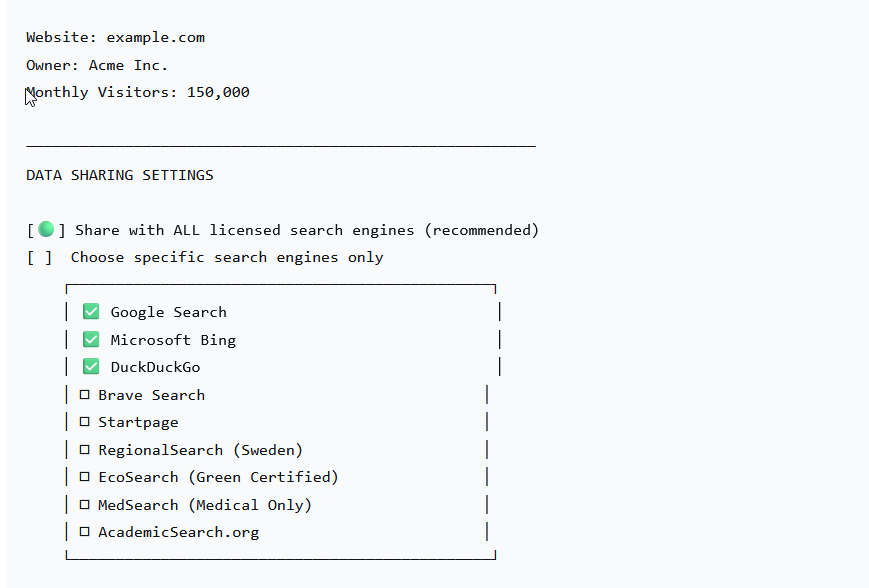
DATA GRANULARITY PER ENGINE (Example)
Here are some basic examples for illustrative purposes about how a website owner (company) can decide what format of anonymously aggregated user data they want to share.
Google Search: [Full Raw Data]
• All 100+ signals at the individual session level
• Real-time streaming access
• Complete dataset of raw data or averaged data
• Maximum ranking accuracy
• Required for Google Search inclusion
Microsoft Bing: [Aggregate Statistics]
• Daily/Monthly aggregates only
• No individual session data
• 7-day data delay
• Lower API cost
DuckDuckGo: [Privacy-Preserving]
• Differentially private aggregates
• 30-day minimum aggregation
• No conversion data shared
• Meets strict privacy standards
Custom Settings for: [Add Engine]...
Example Search Engine Costs:
Basic Access (Preset Algorithms): Free
Aggregate Data: $0.001 per 1000 queries Full Raw Data: $0.01 per 1000 queries
Premium Real-time: $0.05 per 1000 queries
Marketplace Dynamics:
High-value sites can demand revenue sharing
New search engines can access basic data freely
Niche sites can trade data for specialised exposure
Privacy sites can choose limited sharing
Technical Implementation Examples
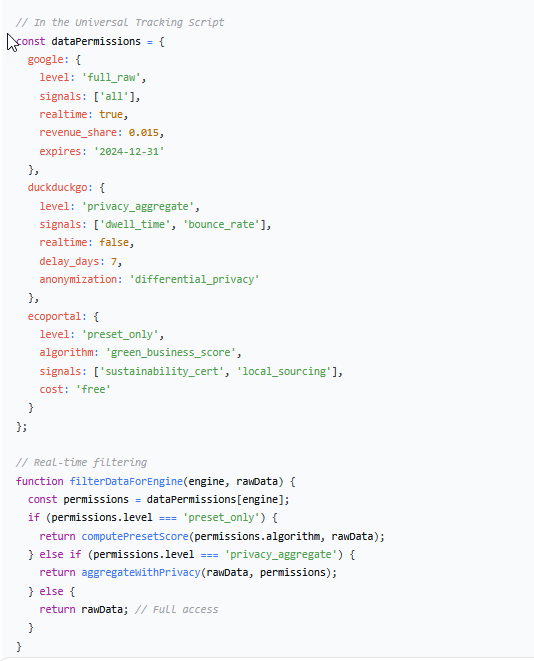
Dynamic Consent Updates:
Website owners can change data sharing permissions in real-time
Search engines see changes within 24 hours
Users see transparency badges: "🔓 Full Data" vs "🔒 Privacy Mode"
Historical data permissions respected (no retroactive changes)
Competitive Effects
For Websites:
Specialisation: Can support niche search engines relevant to their audience
Privacy: Complete control over data sharing
Revenue: New income stream from data access
For Search Engines:
Startups: Can launch with preset access to all sites
Specialists: Can request specific data relevant to their vertical
Incumbents: Must compete on value, not just data access
Innovators: Can propose new algorithms that websites might enable
Privacy Protections & User Consent
Transparency Requirements:
Search Engine Badges:
🔓 Google: Full data access
🔒 DuckDuckGo: Privacy mode
⚖️ Bing: Aggregate data
🌱 EcoSearch: Green algorithm only
Website Disclosures:
"We share conversion data with Search engines
"We share only anonymised aggregates with privacy search engines"
User Controls:
Opt out of data sharing entirely
Choose the preferred search engine data level
See which engines have accessed their anonymised data
Regulatory Compliance:
GDPR: Explicit consent for full data sharing
CCPA: "Do not sell my data" option
Industry-specific regulations (HIPAA, FERPA) respected
International data transfer protocols
Etc, etc, etc.
Restoring Balance in the Search Ecosystem
This framework transforms data from a monopolised asset into a negotiable commodity. Websites become active participants in the search economy, with:
Control over who sees their performance data
Compensation for valuable data sharing
Choice in how they appear in different search contexts
Transparency in the data-sharing relationship
Search Engines Compete in a Dynamic Marketplace where:
Users get better, more search result comparisons
Websites control their data destiny
Search engines innovate to attract both users AND website data
No single entity controls the entire feedback loop
Compete on value proposition alone, rather than data hoarding
This isn't just privacy protection—it's economic rebalancing. By giving websites data sovereignty, we create a search ecosystem that rewards quality, specialisation, and innovation at every level.
Data Retrieval: On-Demand Data vs. Bulk Database Access
Core Concept: Privacy-First, Query-Specific Data Fetching
Instead of granting search engines wholesale access to the entire user behaviour database, the Universal Tracking Protocol implements a privacy-preserving, query-specific data retrieval system:
Two Access Models:
On-Demand Per-Query Fetching (Entry-level edition)
Bulk Historical Database Download (Premium enterprise option)
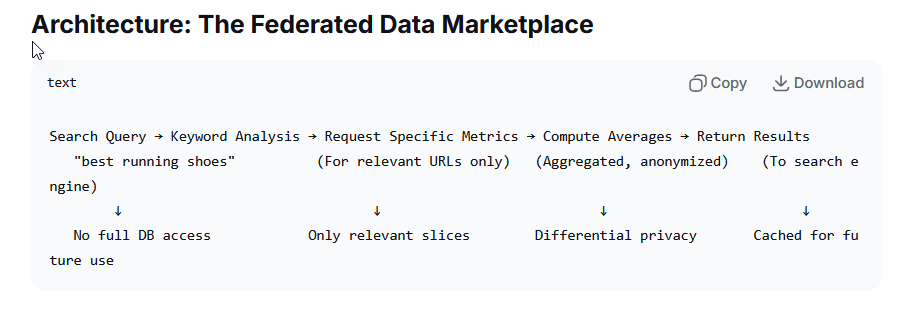
Access Model 1: On-Demand Per-Query Fetching
Search Engine Flow:
1. User searches "organic coffee beans"
2. Search engine identifies candidate URLs
3. Sends API request for ONLY those URLs' performance data
4. Receives aggregated metrics for those specific pages
5. Ranks results based on received data
6. Caches the averages for 24 hours
Privacy Advantages:
Minimal Data Exposure: Search engines only see data for URLs relevant to the
specific queryNo Cross-Query Profiling: Can't connect unrelated searches
Aggregation by Default: Only averages, not individual session data
Differential Privacy: Statistical noise prevents reverse engineering
Security & Privacy for Bulk Access:
Data Minimisation: Only aggregated metrics, no individual sessions
K-Anonymity: All URLs must have a minimum number of sessions
Differential Privacy: Noise added to all metrics
Legal Agreements: Strict usage limitations
Audit Trails: All queries logged and reviewed
Example Cost Structure (Pay-Per-Query):

Compliance Requirements:
GDPR: Explicit consent for ε < 0.5
CCPA: "Do not sell" option removed from bulk downloads
COPPA: Extra protections for children's content
Sector-specific: Healthcare, finance, additional restrictions
The Economic Ecosystem
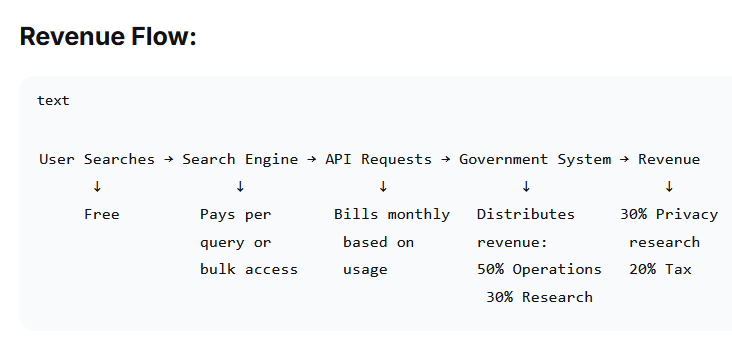
Market Dynamics:
Small engines: Low-cost entry with per-query pricing
Large engines: Economies of scale with bulk access
Specialised engines: Can pay a premium for specific vertical data
Privacy engines: Can use higher ε values for better privacy
The Cold Start Problem Solved
New search engines immediately have aggregate benchmarks, and new pages can be indexed and ranked quickly.

How to Build a Search Engine.
In 2026, building a search engine can range from simple keyword matching to highly sophisticated, AI‑driven semantic search. A search engine can be built as a single‑vendor technology stack, such as Google, or assembled from a range of third‑party open‑source technologies. For example, in Europe, an open‑source technology company called Elasticsearch provides many of the capabilities that internet search engines can use. (If they can get fair access to aggregated user data).
1. Core Architecture
A contemporary search engine is composed of four foundational components, operating together in a continuous feedback loop:
The Crawler (Spider): A programmatic agent that systematically traverses the web—or a defined data source—by following links and retrieving raw content.
The Indexer: A transformation layer that processes raw data by stripping HTML, removing noise (such as stop words), normalising text, and preparing content for efficient retrieval.
The Index (Storage Layer): Typically implemented as an inverted index, analogous to the index at the back of a textbook. It maps terms to the documents in which they occur, enabling fast lookup at query time.
The Ranker (Query Engine): The decision-making core of the system interprets user queries, evaluates relevance signals, and determines the optimal ordering of results. The key requirement for other search engines is the ability to use aggregated, anonymous data to protect user privacy. This will create a level playing field that improves competition and increases user privacy. We discuss a recommended universal tracking system in more detail below.
2. Implementation Steps
A: Data Acquisition (Crawling)
If the search engine is not limited to local or pre-indexed files, a crawler is required to gather content.
Tooling: Python-based frameworks such as Scrapy or libraries like BeautifulSoup are commonly used for MVP's (Minimum viable Products).
Compliance: Crawlers must respect robots.txt directives and rate limits to avoid violating site policies or overwhelming servers.
B): Processing & Indexing
Raw HTML is unsuitable for direct search and must be converted into structured, searchable text.
Tokenisation: Breaking text into discrete terms or tokens.
Normalisation: Converting text to lowercase and applying stemming or lemmatisation so that related terms (e.g. “run,” “running,” “ran”) are treated consistently.
Index Construction: Building an inverted index, often implemented as a hash-based data structure mapping terms to document identifiers and positional data.
C): Ranking & Relevance Modelling
This stage determines which documents appear first and why.
TF-IDF: A foundational relevance model that increases the importance of terms frequent within a document but rare across the wider corpus.
BM25: The industry-standard probabilistic ranking algorithm, offering improved term weighting and document-length normalisation.
Vector Search & Embeddings (AI): Semantic search is vital. Large language models encode text into high-dimensional vectors, allowing the system to retrieve conceptually similar results—even when queries and documents do not share exact keywords.
User Data: Using anonymously aggregated data collected by a universal industry standard script.
D): User Interface & Experience
The front-end should prioritise speed and clarity. At minimum, this includes a search input and a results page (SERP) presenting ranked titles, contextual snippets, and destination links.
E): Key Challenges and Constraints
Scalability: While indexing thousands of documents is straightforward, indexing millions requires distributed systems, horizontal scaling, and index sharding. This will require an initial investment to gain traction quickly.
Freshness: Content changes constantly, necessitating intelligent re-crawl strategies that balance update frequency with infrastructure cost.
Spam & Manipulation: Effective search engines must detect and suppress low-quality content, link manipulation, and other adversarial ranking tactics.
SEO (Search Engine Optimisation)
Search Engine Optimisation (SEO) encompasses a set of established techniques designed to improve a website’s organic visibility across Google and other search engines. However, these capabilities are now commoditised; virtually all modern search engines can interpret and apply on-page signals with comparable effectiveness.
On-page SEO: Focuses on optimising elements within the website itself, including meta tags, headings, internal linking, and the use of target keywords within content. These signals help search engines understand page relevance, structure, and topical alignment.
Off-page SEO: Centres on backlinks—links from external websites that signal authority and trust. This approach originates from Google’s original PageRank algorithm, where links acted as citations of credibility.
Relative Impact: While on-page and off-page SEO remain necessary foundations, their influence on rankings is increasingly marginal when compared to user-level behavioural data, such as engagement, dwell time, and interaction patterns. These signals provide far stronger feedback loops for modern search algorithms and now play a more decisive role in ranking outcomes.
Other Companies with Tracking Scripts
Hundreds of technology companies have their own tracking scripts, but these are installed on only a tiny fraction of websites compared to Google’s.
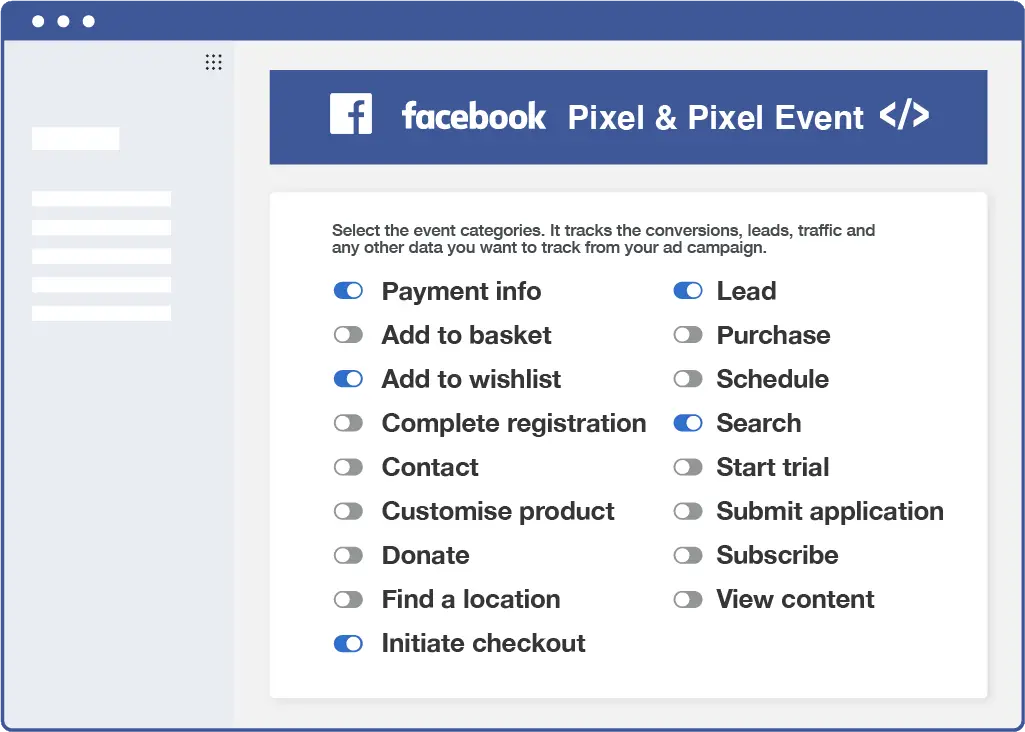
Facebook’s tracking script is one of the most widely installed third-party advertising scripts, second only to Google’s ecosystem (Google Analytics, Google Tag Manager, and Google Ads conversion tracking). This widespread deployment significantly strengthens Facebook’s advertising platform by providing high-quality behavioural data for optimisation and measurement.
Without the Facebook Pixel, Meta ads largely revert to upper-funnel targeting such as brand awareness. With the Pixel in place, campaigns can optimise toward bottom-of-the-funnel leads and sales.
Industry practitioners and Meta’s own case studies consistently indicate that campaigns run without the Facebook Pixel (or the Conversions API) materially underperform, with some estimates suggesting performance can be up to 70% less effective compared to campaigns with proper conversion tracking in place. So around of Facebook's sales revenue is dependent on using first-party data collected away from Facebook on other websites and apps.
The Facebook tracking Pixel enables Meta to match its users with on-site activity, allowing user behaviour and interests to be captured for more accurate targeting and the creation of lookalike audiences. By tracking key events such as page views, form submissions, add-to-cart actions, and purchases, the Pixel provides the data required to optimise targeting using AI machine learning.
While results vary by business and implementation, the absence of conversion signals can reduce Return on Ad Spend (ROAS) by a substantial margin. In effect, without a Pixel, advertisers are not merely losing visibility—they are depriving Meta’s delivery system of the data required to optimise effectively, significantly weakening the AI models that make Facebook advertising profitable at scale.
Facebook can also gain limited visibility into visits originating from Google search, as its tracking script can identify website traffic sources. In some cases, Facebook can infer probable search intent by analysing page-level metadata such as page titles and descriptions. As with search engines, social media websites will now need to use the new universal tracking script.
Summary
Google’s dominance in search has long been attributed to an unbeatable algorithm powered by advanced AI. This belief is largely a myth. The core mechanics of search—crawling, indexing, matching, and ranking—are well understood and widely implemented across the industry. What competitors have lacked is not algorithmic capability, but access to behavioural user data at scale, particularly what happens after a user clicks a search result.
Google’s true competitive advantage lies in its ability to observe the full search journey: from query, to click, to post-click behaviour, and ultimately to task completion or abandonment. Through its ecosystem—Search, Chrome, Android, Google Analytics, and related tooling—Google has been uniquely positioned to measure dwell time, return-to-search behaviour, conversions, and satisfaction signals across much of the web. These aggregated signals allow Google to rank content based on what users demonstrably prefer, effectively letting users “vote” on results through their behaviour.
The recent U.S. Department of Justice antitrust ruling marks a structural shift. While the court stopped short of breaking up Google, it concluded that Google unlawfully maintained monopoly power in search and imposed remedies designed to restore competition. Central among these is a requirement for Google to share certain search-related data with qualified competitors—acknowledging that data access, not algorithmic secrecy, is the primary barrier to competition.
This reframes how search engines should be understood. Google Search operates less like an editorial system and more like a large-scale market mechanism: rankings emerge from aggregated outcomes, not subjective judgments. The same principle is observable in other product-based search engines such as Amazon and Udemy, where conversion rate and user satisfaction dominate ranking outcomes, with other signals acting mainly as tie-breakers or stabilisers.
The implication is profound. If post-click behavioural data can be shared in an anonymised, aggregated, privacy-preserving way, the barriers to building competitive search engines fall dramatically. Search quality would then depend on how well an engine interprets shared signals—not on who owns the largest private surveillance network. This will also lay a platform for more innovation.
Ultimately, this article argues that restoring competition in search is not about dismantling Google’s technology, but about correcting a data imbalance. By treating aggregated user-outcome data as an essential facility—subject to regulation and equal access—it becomes possible to realign search with its original purpose: ranking information based on collective human preference, not monopoly control.