
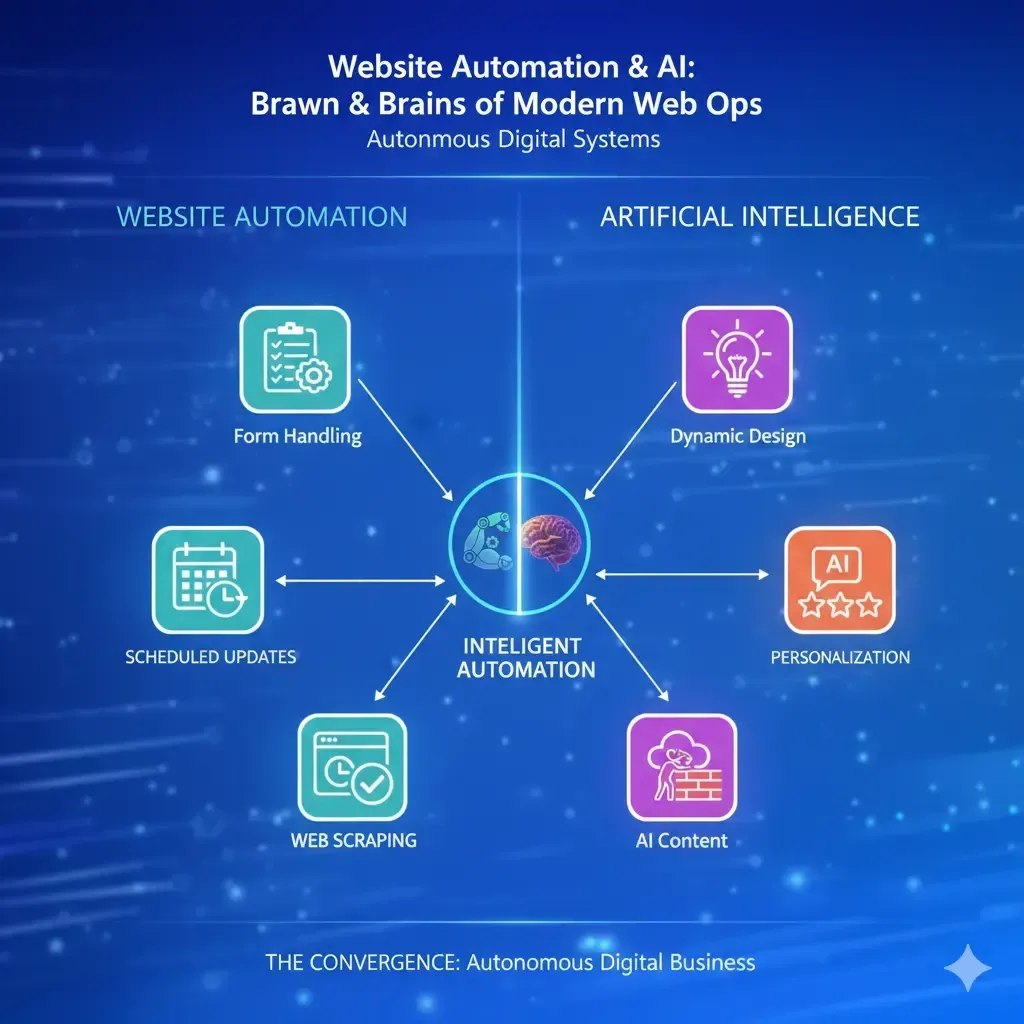
Website Automation and AI: The Brawn and Brains of Modern Web Operations
For most of the internet’s history, websites were static digital brochures. They displayed information, captured basic enquiries, and relied heavily on human teams to execute marketing, sales, and operations workflows manually.
That paradigm is rapidly collapsing.
Modern websites are evolving into autonomous operational engines—systems that capture leads, personalise experiences, qualify prospects, orchestrate workflows, and even make decisions without human intervention.
At the core of this transformation are two foundational technologies:
Website Automation — the Brawn
Artificial Intelligence — the Brains
Automation delivers speed, reliability, and execution at scale. AI delivers cognition, adaptation, and strategic intelligence.
Together, they represent a structural shift in how digital businesses operate, enabling organisations to scale revenue and operations without proportional increases in headcount.
This article explores the technical, operational, and commercial implications of website automation and AI, their distinct roles, and their convergence into intelligent and agentic automation systems that are redefining digital business models.
Definition of Website Automation:
Website automation refers to the use of software, scripts, and integrations to execute predefined tasks on websites without human intervention. These tasks follow deterministic logic—commonly structured as if-then rules—and perform actions consistently and repeatedly.
Automation is fundamentally about execution. It does not reason or adapt independently; it executes instructions precisely as defined.
In operational terms, website automation turns a website into a process engine rather than a passive interface.
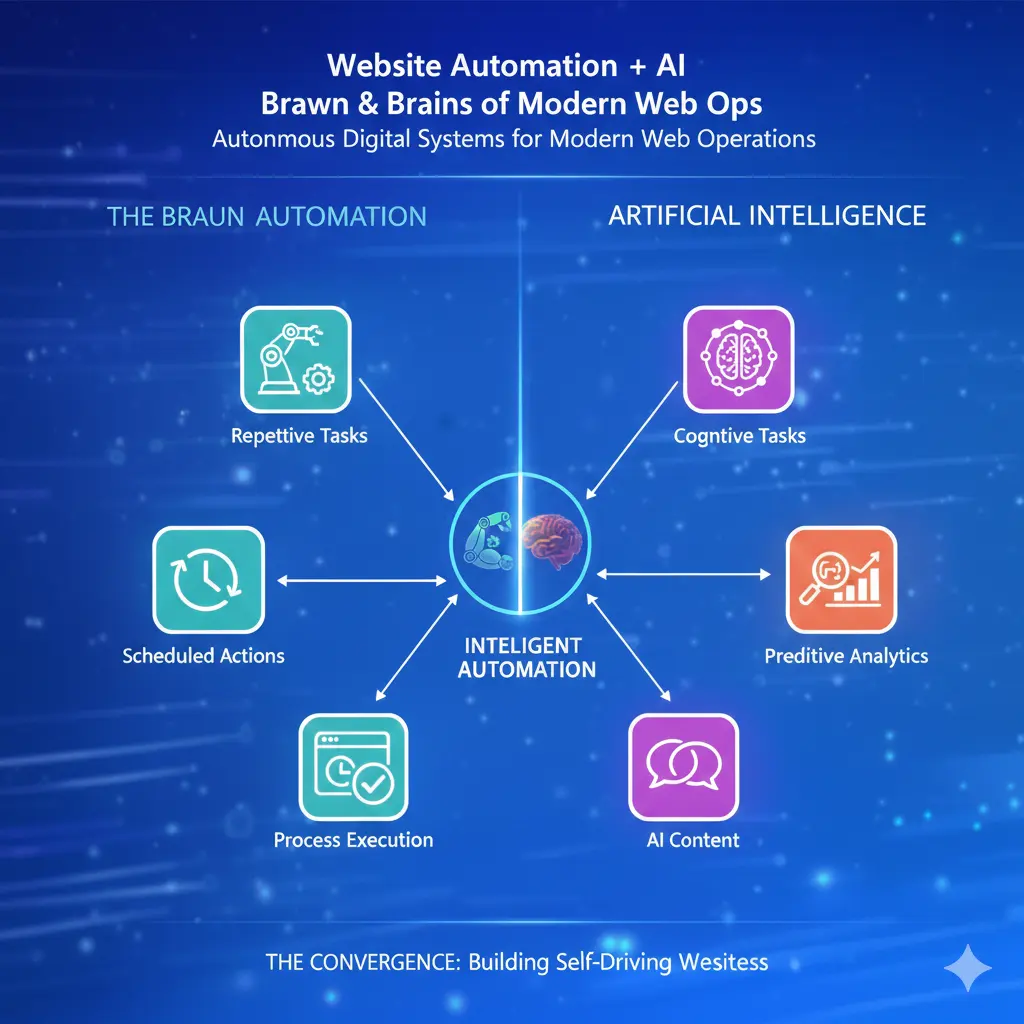
Core Tasks in Website Automation
1. Form Handling and Data Transfer
Automated systems can capture form submissions, validate inputs, and transfer data to CRMs, databases, or analytics platforms instantly.
Examples include:
Submitting contact form data to HubSpot or GoHighLevel
Creating CRM records automatically
Triggering follow-up workflows
This eliminates manual data entry and reduces latency between lead capture and response.
2. Web Scraping and Data Extraction
Automation tools can extract structured and unstructured data from websites, including:
Product prices
Competitor listings
News articles
Contact details
These datasets can feed market intelligence dashboards, pricing engines, or AI models.
3. Scheduled Content and System Updates
Automation schedules and executes tasks such as:
Publishing blog posts
Updating product listings
Syncing inventory
Triggering maintenance scripts
This ensures consistency and removes dependence on manual scheduling.
4. Automated Testing and Quality Assurance
Testing automation tools such as Selenium, Cypress, Playwright, and Puppeteer simulate user interactions across browsers and devices to verify site functionality.
Automated testing ensures:
Forms work correctly
Checkout flows are functional
Responsive layouts display properly
Performance regressions are detected
This is critical for maintaining high-availability digital systems.
Benefits of Website Automation
Speed and Scalability
Automated processes execute tasks in milliseconds and can scale to thousands of actions simultaneously—far beyond human capability.
Consistency and Error Reduction
Automation eliminates human variability and fatigue, ensuring tasks are executed identically every time.
Operational Efficiency
Businesses often report 30–80% reductions in manual administrative workload after implementing automation workflows.
Cost Efficiency
Automated systems replace repetitive labour, reducing operational costs and allowing human teams to focus on strategic tasks.
Limitations of Traditional Automation
Despite its strengths, traditional automation has structural limitations:
Rigid Logic: Automation cannot adapt beyond predefined rules.
Fragility: Scripts often break when website layouts change.
No Understanding: Automation cannot interpret content, sentiment, or intent.
This is where AI becomes essential.
Artificial Intelligence in Web Operations: The Brains
Definition of AI in Web Contexts
Artificial Intelligence refers to computational systems that simulate human cognitive functions such as learning, reasoning, perception, and language understanding.
Unlike automation, AI systems are probabilistic and adaptive, capable of improving over time as they process data.
Core AI Capabilities in Web Environments
1. Dynamic Website Design and Generation
AI-driven website builders such as Wix ADI and emerging generative UI tools can create layouts, content structures, and UX flows based on user prompts.
These systems analyse:
Business type
User intent
Industry benchmarks
Conversion heuristics
The result is data-driven design automation rather than manual UX design.
2. Personalisation Engines
AI systems such as Salesforce Einstein, HubSpot AI, and custom ML models analyse behavioural data to personalise user experiences.
Examples include:
Product recommendations based on browsing history
Personalised CTAs based on lifecycle stage
Dynamic pricing or offers
Personalisation is a key driver of conversion rate optimisation, with empirical studies showing 10–30% conversion uplifts in personalised experiences.
3. AI-Generated Content
AI tools such as Jasper, GPT-based models, and proprietary enterprise systems generate:
Blog articles
Product descriptions
FAQs
Ad copy
These systems use NLP and semantic models to produce SEO-optimised content at scale, significantly reducing content production costs.
4. Predictive Analytics and Behaviour Modelling
Machine learning models predict:
Lead conversion probability
Customer churn risk
Purchase likelihood
Optimal messaging timing
This shifts websites from reactive interfaces to predictive digital systems.
Advantages of AI in Web Operations
Cognitive Capability
AI systems interpret meaning, sentiment, and context—capabilities that deterministic automation lacks.
Adaptability
AI models can adjust to new data, evolving user behaviour, and changing site structures.
Strategic Decision Support
AI provides recommendations and decisions that optimise marketing, sales, and operational outcomes.
The Intersection: Intelligent and Agentic Automation
The most transformative development is not automation alone or AI alone, but their convergence into Intelligent Automation.
AI decides. Automation executes.
This paradigm creates systems that can operate autonomously across digital workflows.
Intelligent Automation Architecture
Intelligent automation typically consists of three layers:
Perception Layer (AI)
NLP, computer vision, ML models
Decision Layer (AI logic and orchestration)
Classification, prediction, planning
Execution Layer (Automation)
APIs, workflows, scripts, integrations
This architecture mirrors human organisational structures: cognition, decision-making, and execution.
Self-Healing Automation Scripts
Traditional automation scripts fail when HTML structures change.
AI-enhanced tools such as Testim, Mabl, and Functionize use computer vision and ML to identify UI elements visually rather than relying solely on DOM selectors.
If a button moves or code changes, AI can still recognise the element and continue execution.
This capability dramatically reduces maintenance overhead and downtime.
AI Agents: Autonomous Web Operators
AI agents represent the next phase of web automation.
Instead of executing fixed scripts, agents receive high-level goals such as:
“Research competitor prices and summarise changes weekly.”
The agent will:
Navigate websites
Extract data
Analyse patterns
Generate reports
Trigger follow-up workflows
This represents a shift from procedural automation to goal-driven autonomy.
Workflow Orchestration with AI and Automation
Platforms such as Zapier, Make, n8n, and enterprise orchestration tools integrate AI decision-making with automation execution.
Example workflow:
Incoming email received
AI classifies intent (sales, complaint, support)
Automation routes to CRM, Slack, or support system
AI drafts a response
Automation sends or escalates
This reduces response times, improves customer experience, and scales service operations without additional staff.
Real-World Applications Across Industries
E-Commerce
Dynamic Pricing
AI monitors competitor prices and demand signals, while automation updates product pricing in real time.
Personalised Shopping
AI recommends products based on behavioural patterns, increasing average order value.
Inventory Automation
Predictive models forecast demand, triggering automated restocking workflows.
Customer Support
Intelligent Chatbots
AI chatbots handle complex queries, escalating only edge cases to human agents.
Automated Ticket Routing
NLP categorises support tickets and assigns them to the correct team automatically.
Self-Service Systems
Automation triggers troubleshooting workflows and knowledge base responses.
Marketing and SEO
AI Content Optimisation
AI suggests content improvements, internal linking structures, and keyword targeting.
Automated Ad Testing
Automation rotates creatives and bids while AI analyses performance patterns.
Social Media Automation
AI personalises posts and automation schedules, publishing across channels.
Competitive Intelligence and Market Research
Continuous Monitoring
Automated scraping combined with AI analysis detects competitor strategy changes.
Trend Detection
ML models identify emerging market patterns and consumer behaviour shifts.
Technical Stack Behind Website Automation and AI
Core Systems
CRM Platforms: HubSpot, GoHighLevel, Salesforce
Automation Platforms: Zapier, Make, n8n
Tracking Infrastructure: Google Tag Manager, server-side tracking, event pipelines
AI APIs: GPT models, Claude, Gemini
E-commerce Integrations: Shopify, WooCommerce, Stripe
Analytics and BI: Looker Studio, BigQuery, custom dashboards
These systems form the backbone of modern Revenue Operations architectures.
Quantifiable Business Impact
Empirical results from automation and AI implementations typically include:
20–60% uplift in conversion rates
30–80% reduction in manual administrative tasks
25–50% shorter sales cycles
Improved attribution and data quality for AI models
Scalable growth without proportional hiring
From a financial perspective, automation and AI directly increase revenue per employee, a core metric for enterprise scalability.
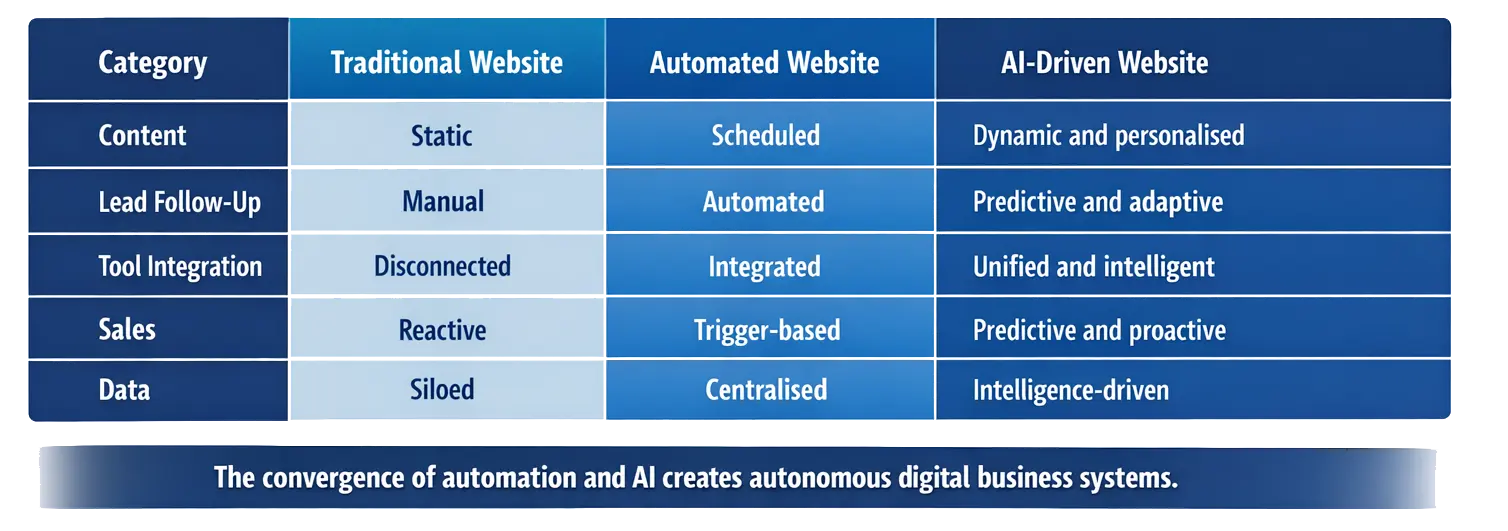
Automation vs AI: A Structural Comparison
Ethical, Legal, and Technical Challenges
Technical Complexity
AI systems require training, monitoring, and governance. Automation requires integration engineering and maintenance.
Anti-Bot and Platform Restrictions
CAPTCHAs, rate limits, and platform policies restrict scraping and automation activities.
Ethical Considerations
Data privacy, consent, and terms-of-service compliance are critical, particularly under GDPR and emerging AI regulations.
Organisational Change
Automation and AI shift roles within organisations, requiring reskilling and new governance frameworks.
Getting Started: Practical Implementation Pathways
For Beginners
Use no-code tools such as Zapier and Make
Implement simple workflows (form → CRM → email)
Use AI tools for content generation
Learn basic HTML and APIs
For Developers
Learn Python automation frameworks (Selenium, Playwright)
Build scraping pipelines
Integrate AI APIs
Implement server-side tracking and data pipelines
For Enterprises
Implement unified CRM and data infrastructure
Build AI-driven decision engines
Deploy orchestration platforms
Establish governance and compliance frameworks
Future Trends: Towards Autonomous Digital Organisations
Agentic Systems
AI agents will autonomously execute complex workflows end-to-end, reducing the need for manual orchestration.
Browser-Native AI
Browsers are integrating AI capabilities directly, enabling automation at the client layer.
Self-Healing Digital Infrastructure
AI systems will detect and repair broken workflows automatically.
Democratisation of Automation
Low-code and natural language interfaces will make enterprise-grade automation accessible to non-technical users.
Revenue Operations Convergence
Websites will become central nodes in Revenue Operations systems, coordinating marketing, sales, support, and finance workflows.
Strategic Insight: The Website as an Autonomous Business Engine
The website is no longer a marketing asset—it is becoming a core operational system.
In the next 3–5 years, leading organisations will operate websites that:
Qualify leads autonomously
Personalise experiences in real time
Execute sales workflows
Trigger operational processes
Learn and optimise continuously
This represents a shift from websites as interfaces to websites as autonomous revenue and operations platforms.
Conclusion: The Brawn and Brains Paradigm
Website automation and AI are not competing technologies—they are complementary layers of a single operational paradigm.
Automation is the Brawn: executing tasks with speed, precision, and scale.
AI is the Brains: learning, adapting, and making decisions.
Together, they create intelligent digital systems capable of operating businesses at machine scale.
For organisations that adopt this architecture early, the competitive advantage is structural: lower costs, faster growth, superior customer experiences, and data-driven decision-making at every layer.
For organisations that do not, the risk is existential.
The future of digital business is not human-operated websites.
It is autonomous web operations driven by intelligent automation and AI cognition.