

Zapier AI Bots: A Deep-Dive into Intelligent No-Code Automation for Modern Operations
Automation has long promised efficiency, but traditional rule-based workflows inevitably hit a ceiling. Real business inputs are messy: emails ramble, forms are half-completed, chats drift off-script, and intent is rarely explicit. This is the gap Zapier AI Bots were designed to close.
Built on top of Zapier’s automation engine, AI Bots introduce a reasoning layer powered by large language models (LLMs). Instead of executing only deterministic if-this-then-that rules, these bots interpret language, infer intent, normalise unstructured data, and decide what to do next—without requiring code.
This article provides a technical, operational, and strategic breakdown of Zapier AI Bots (also referred to as Zapier Chatbots or Agents), how they work, where they excel, and where their limits are—so you can deploy them with intent rather than novelty.
What Are AI Bots in Zapier?
AI Bots in Zapier are LLM-powered inference layers embedded inside automations (Zaps). They add intelligence at the point where rigid logic fails—interpreting meaning rather than matching conditions.
Zapier positions these capabilities across several features:
AI by Zapier
Zapier Chatbots
Zapier Central (Agents)
AI Actions & Natural Language Actions (NLA)
Zapier Interfaces
Architecturally, they serve a single purpose:
Insert intelligence into workflows where rules alone break down.
In practice, this allows Zapier to:
Understand unstructured human inputs (emails, chats, documents)
Decide routing and actions based on intent
Extract structured data from free text
Generate summaries, classifications, and responses
Act as a lightweight “digital operator” inside workflows
They are not fully autonomous agents in the computer-science sense. Instead, they are goal-aware reasoning components embedded within linear automations.
Two Branches of Zapier AI Bots
Zapier’s AI capabilities fall into two distinct operational categories, each optimised for different problems.
1. Zapier Chatbots (Customer-Facing AI)
Zapier Chatbots are interactive, conversational interfaces designed for external users—customers, leads, or employees.
Core Characteristics
Embedded on websites, shared via links, or hosted in Interfaces
Powered by LLMs (e.g. GPT-4o mini)
Designed to respond, collect, and trigger
Key Capabilities
Knowledge-Driven Responses (RAG)
Chatbots can be trained using:
PDFs, CSVs, text files (up to ~1MB)
Website URLs (e.g. help centres)
Zapier Tables or connected apps
They use Retrieval-Augmented Generation (RAG) to ensure responses are grounded in your data—not generic model knowledge.
Lead Capture & Qualification
You can configure bots to:
Ask for name, email, company, budget
Gate conversations before or after interaction
Push captured data directly into CRMs such as HubSpot or Salesforce
Actionable Conversations
Chatbots support Zap Buttons—interactive actions embedded directly in the chat UI.
When clicked, they can:
Book meetings
Create CRM records
Send emails or Slack messages
Trigger downstream workflows
Result: Conversations that do something, not just answer questions.
2. Zapier Central & Agents (Internal AI Teammates)
Zapier Central—often referred to as Zapier Agents—is designed for internal, goal-oriented automation.
How Agents Differ from Standard Zaps
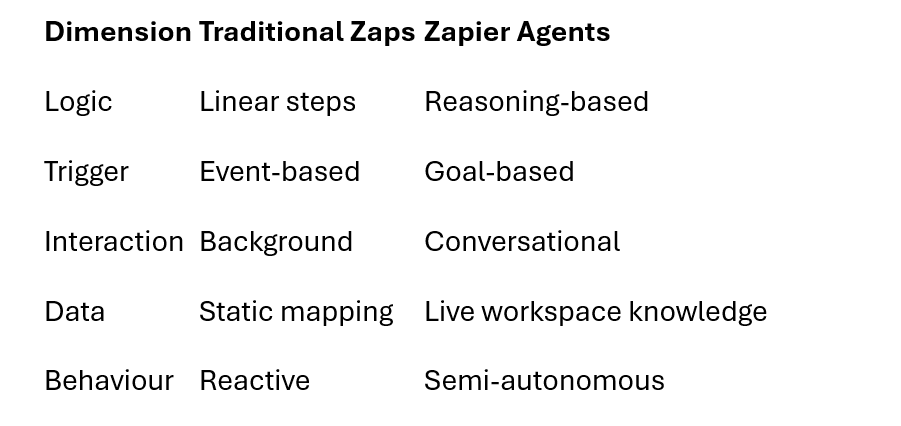
Agents behave like AI teammates inside your operations stack.
Example Internal Use Cases
Preparing sales call briefings from CRM + web data
Summarising meetings from Fathom or Zoom transcripts
Troubleshooting broken Zaps
Generating automation ideas from plain-English prompts
Triage and escalation of internal tickets
Agents can run:
On a schedule
On an event (e.g. new ticket)
On demand via conversational input
They operate quietly in the background, optimising internal workflows rather than engaging end-users.
How Zapier AI Bots Work: The Architecture
At a systems level, Zapier AI Bots follow a Perception → Reasoning → Action loop.
1. Trigger
A workflow begins with an event:
New form submission
Incoming email
Chat message
CRM update
Webhook payload
2. AI Reasoning Step (Inference Layer)
This is where intelligence enters the workflow.
The AI Bot can:
Interpret intent
Extract entities
Classify or score inputs
Summarise long content
Decide routing logic
Generate structured outputs (JSON-like fields)
3. Downstream Actions
Based on the AI output, the Zap executes actions:
Update CRM records
Send emails or SMS
Create tasks or tickets
Notify teams
Trigger other Zaps
This replaces brittle filter chains with human-like interpretation inside machine workflows.
Underlying AI Technology
Zapier abstracts the AI layer to prioritise accessibility.
Supported model providers include:
OpenAI
Anthropic (select contexts)
What you don’t manage:
Tokens
Temperature
Model switching
API authentication
This design choice makes Zapier highly accessible for business teams—but introduces less granular control than platforms like Make or custom agent frameworks.
Core Capabilities of Zapier AI Bots
1. Natural Language Understanding (NLU)
AI Bots can parse:
Free-text form fields
Email bodies
Chat transcripts
Notes and call summaries
Example input:
“We’re a 50-person SaaS company looking to migrate from HubSpot and need offline conversion tracking.”
Extracted structure:
Company type: SaaS
Size: 50 employees
Intent: CRM migration
Requirement: Offline conversion tracking
This eliminates regex, manual reviews, and complex conditional paths.
2. Intelligent Classification & Routing
AI Bots excel where rigid logic fails.
Common classifications:
Sales vs Support vs Billing
Lead quality (High / Medium / Low)
Topic detection
Sentiment and urgency
Example routing:
Sales → Create deal + notify sales
Support → Create ticket
Spam → Ignore
At scale, this dramatically reduces automation complexity.
3. Structured Data Extraction
Zapier AI Bots can convert messy inputs into clean fields.
Input:
“Budget is around £3–5k per month, need Google Ads and CRM.”
Output:
Budget_min: 3000
Budget_max: 5000
Channel: Google Ads
CRM_required: Yes
This enables reliable downstream automation even with inconsistent user inputs.
4. Dynamic Content Generation
Bots can generate:
Email replies
CRM notes
Slack summaries
Task descriptions
Proposal outlines
Unlike static templates, outputs adapt to:
Context
Tone
Prior steps
Extracted data
For internal operations, 80% accuracy at scale often beats perfection.
5. Lightweight Context (Stateless by Design)
Zapier AI Bots:
Can reference previous steps within a single Zap run
Can use variables and payloads
They cannot:
Remember past runs
Learn over time
Maintain persistent conversational memory
Any “memory” must be stored externally (CRM, tables, databases).
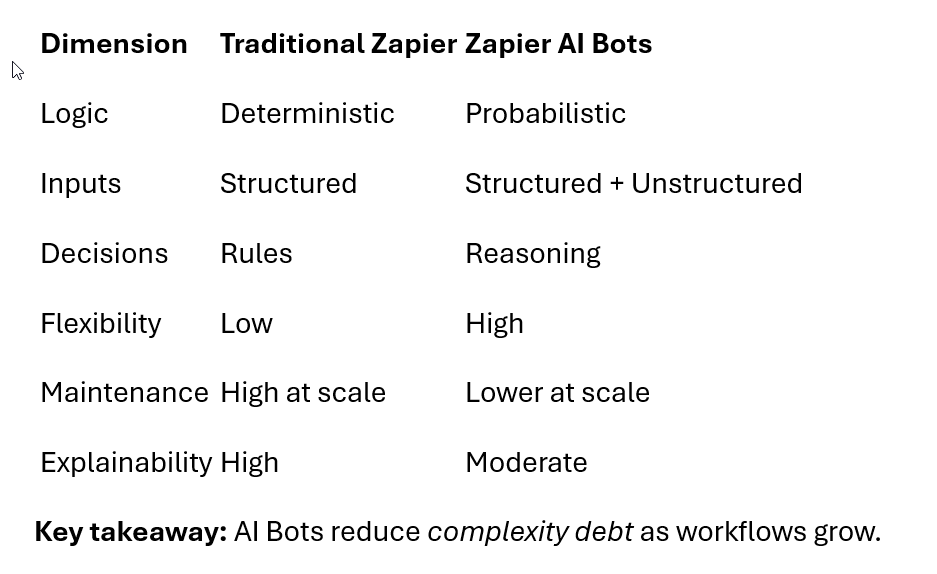
Zapier AI Bots vs Traditional Automation
High-ROI Use Cases
Lead Intake & Qualification
Interpret enquiry intent
Score leads
Route intelligently
Email & Inbox Triage
Categorise messages
Draft replies
Assign owners
CRM Data Hygiene
Standardise notes
Auto-tag records
Normalise fields
Internal Operations
Convert messy requests into tasks
Generate summaries
Reduce admin overhead
Cross-App Translation
Convert human language into API-ready fields
Strategic Limitations to Understand
1. No True Autonomy
Bots only act where placed. They do not independently plan strategies.
2. No Persistent Memory
Each execution is stateless.
3. Less Control Than Advanced Platforms
You cannot:
Chain multiple reasoning loops
Dynamically call tools mid-inference
Build agent hierarchies
Zapier deliberately prioritises simplicity over depth.
Zapier AI Bots in Strategic Context
Zapier AI Bots sit between:
Basic automation
Full agent frameworks
They are best described as:
Embedded intelligence, not autonomous agents.
Ideal For
RevOps
Marketing operations
Sales operations
Internal tooling
SMB and mid-market automation
Not Ideal For
Complex orchestration
Multi-agent systems
Heavy RAG architectures
Stateful AI assistants
Forward-Looking Perspective (2026+)
Zapier is clearly moving toward:
AI-first Zap creation
Natural-language workflow design
Embedded AI decision steps by default
Agent-like behaviour through UI abstractions
However, the philosophy remains consistent:
AI enhances automation—it does not replace system design.
For agencies and operators, Zapier AI Bots should be deployed as:
Interpretation layers
Decision accelerators
Human effort reducers
Not as standalone “AI employees.”
Executive Summary
Zapier AI Bots introduce reasoning into no-code workflows
They excel at unstructured inputs, classification, and content generation
They reduce maintenance overhead at scale
They are not autonomous agents
Best suited for RevOps, marketing ops, sales ops, and internal automation
If you design them intentionally, Zapier AI Bots become one of the highest-leverage upgrades you can make to a modern operations stack.